










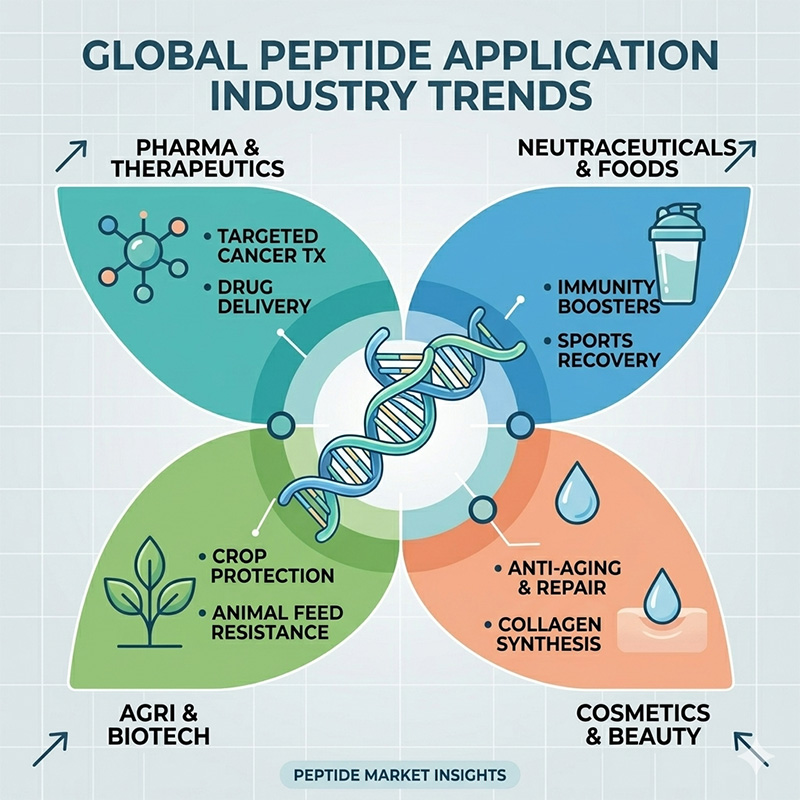
The global peptide supplement market is projected to reach USD 71.8 billion by 2030, growing at a CAGR of 8.9%. This growth is driven by a convergence of clinical evidence, manufacturing advances, and a generation of consumers who read PubMed abstracts before they read product reviews.
Why Peptides Are Dominating the 2026 Supplement Market
Several structural forces have placed bioactive peptides at the center of premium formulation strategy.
Aging demographics. The global population aged 60+ is expected to reach 2 billion by 2050. This demographic seeks targeted interventions for mobility, cognition, skin health, and metabolic function — and peptides map directly to these needs.
Consumer education. Social media has accelerated the spread of peptide science from academic journals to consumer awareness, often within months of a new study.
Manufacturing cost reduction. Advances in solid-phase peptide synthesis (SPPS) and enzyme-catalyzed fermentation have cut peptide production costs by 35-50% since 2020, making peptide-formulated supplements accessible to mid-market brands.
Top 5 Peptide Categories in Demand (2026)
1. Collagen Peptides
The largest segment by revenue (USD 8.2B in 2026, CAGR 9.1%). Key sources: bovine hide, marine fish skin, chicken sternum. Marine collagen commands a 25-35% price premium due to higher bioavailability and cleaner labeling.
2. Bioactive Peptides
The fastest-growing segment at 11.3% CAGR. Key examples: Lactotripeptides (LTPs) — supported by 30+ clinical trials for blood pressure support; Lactium — a milk-derived decapeptide for relaxation and sleep; Ovotransferrin — an egg white protein for gut and immune health.
3. Glutathione & Precursor Peptides
S-Acetyl Glutathione (SAG) crosses cell membranes 3x more efficiently than standard glutathione. N-acetylcysteine (NAC) remains the most cost-effective glutathione precursor, widely used in liver support and respiratory formulas.
4. Copper Peptides & GHK-Cu
GHK-Cu (glycyl-histidyl-lysine copper peptide) drives collagen stimulation and cellular repair. The market is projected at USD 620M in 2026, with applications in beauty-from-within supplements, post-procedure recovery, and hair/nail health.
5. Growth Hormone Modulating Peptides (CJC-1295, Ipamorelin)
Generating significant B2B inquiry volume despite regulatory complexity. Important: These peptides are not approved dietary ingredients in the US or EU. Market as “research use only” and consult regulatory counsel.
Clinical Applications Driving Formulation
Skin Health: Oral collagen peptide supplementation (2.5-10g/day) has shown statistically significant improvements in skin elasticity, hydration, and wrinkle depth across 23 RCTs. EFSA has authorized a qualified health claim for collagen hydrolysate.
Cognitive Function: Collagen peptides support brain health through the gut-brain axis. Emerging bioactive peptides for cognitive support are a high-growth R&D priority.
Metabolic Health: DDP-4 inhibitor peptides from food sources target the incretin system — a non-pharmaceutical approach to blood sugar support.
Manufacturing Challenges for B2B Buyers
Purity grades matter: Industry standards range from Research Grade (>=95%, lab use only) to USP-NF Grade (>=97%) and Premium Supplement Grade (>=98.5% for clinical-positioned brands). Low-purity peptides may contain incorrect sequences and residual synthesis chemicals.
Synthesis methods: SPPS dominates synthetic peptide production; enzyme fermentation is preferred for naturally occurring peptides and clean-label positioning.
CoA checklist: Always request HPLC purity assay, mass spectrometry identity confirmation, heavy metals testing (Pb <=10ppm, As <=3ppm, Cd <=1ppm, Hg <=0.1ppm), residual solvents, and 24-month stability data.
Strategic Recommendations for 2026
1. Prioritize purity over price: Invest in third-party ISO 17025 testing for every batch.
2. Embrace multi-peptide stacks: The most innovative 2026 formulas combine collagen, bioactive peptides, and glutathione precursors.
3. Diversify supply chain: Maintain relationships with 2-3 vetted suppliers to avoid single-source risk.
4. Monitor regulatory shifts: The FDA is intensifying scrutiny of growth hormone-modulating peptides.