










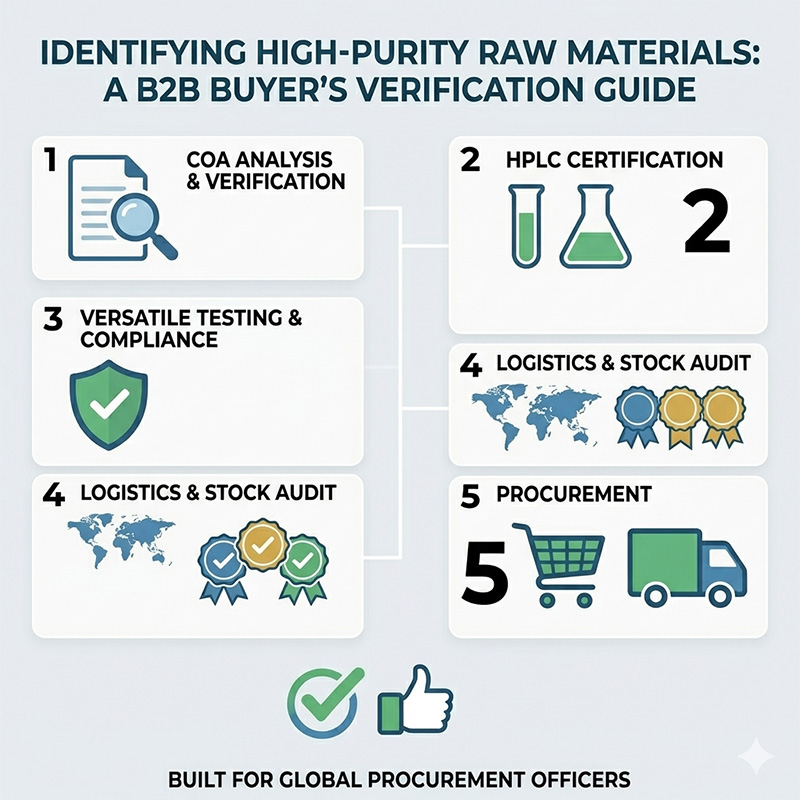
In the USD 180 billion global dietary supplement industry, raw material quality is the single most consequential decision a brand can make. According to the Council for Responsible Nutrition’s 2025 Supply Chain Survey, 34% of supplement brands experienced at least one significant supplier quality issue in the preceding 24 months. The average cost of a single product recall is USD 2.3 million.
This guide covers the laboratory testing methods, CoA interpretation, and red flags every B2B procurement team needs to know.
Understanding Purity Grades
Pharmaceutical Grade (USP-NF / EP): Meets USP or EP standards. Full monograph testing, typically >=98.5% purity. Required for clinical trials and premium brand formulations.
Food / Dietary Supplement Grade (21 CFR Part 111): Meets FDA requirements for dietary supplements. Typical purity >=95%. Acceptable for most commercial products.
Research Grade: Not suitable for human consumption. May contain solvents and byproducts. Commonly mistaken for supplement-grade — a costly sourcing error.
CoA vs. CoC: Always demand a Certificate of Analysis (CoA) — batch-specific test results from a lab. A Certificate of Conformance (CoC) is a manufacturer’s self-declaration with no independent verification.
7 Lab Testing Methods Every Buyer Should Know
1. HPLC — High-Performance Liquid Chromatography: Quantifies active compound purity (%). Standard spec: >=97%, individual impurities <=0.5%, total <=1.0%.
2. Mass Spectrometry (GC-MS / LC-MS): Confirms molecular identity and detects unknown impurities, residual solvents, and heavy metals.
3. Heavy Metal Testing (ICP-MS): Standard limits — Pb <=10ppm, As <=3ppm, Cd <=1ppm, Hg <=0.1ppm. Critical for mushroom extracts and marine collagen.
4. Microbial Testing (USP <61>/<62>): Tests for Total Plate Count, E. coli, Salmonella, and Staphylococcus aureus. Botanical materials carry the highest microbial risk.
5. Residual Solvent Testing (GC-FID): Required for extracted and synthesized ingredients. Comply with ICH Q3C limits.
6. Particle Size Analysis: D90 <200 micrometers required for capsule filling. Affects bioavailability and dosage consistency.
7. Optical Rotation: Confirms stereochemistry for chiral compounds (amino acids, peptide isomers). Out-of-range results suggest adulteration.
How to Read a CoA — 7-Step Checklist
. Batch number matches your shipment
2. Testing date is within 6 months
3. Lab is ISO 17025 accredited
4. Method is specified (e.g., “HPLC per USP <621>”)
5. All specs have limits AND actual results
6. QC approval signature is present
7. Call the lab to verify results (5 minutes, eliminates fraud risk)
Supplier Verification Checklist
– [ ] GMP/cGMP certified (NSF, SQF, or BRCGS)
– [ ] ISO 17025 third-party lab testing
– [ ] Full CoA available before order
– [ ] Heavy metal + microbial testing included
– [ ] 24-month stability data
– [ ] Country of origin disclosed
– [ ] Sample available for independent testing
– [ ] Shelf life / retest date stated
Red Flags — Walk Away If You See These
– CoA older than 12 months
– Lab is not ISO 17025 accredited
– Results reported as “typical” not exact
– Refuses to provide heavy metal or microbial testing
– Prices 40%+ below market average
– No GMP certification
– No stability data available
– Cannot provide country of origin
– Cannot provide samples