










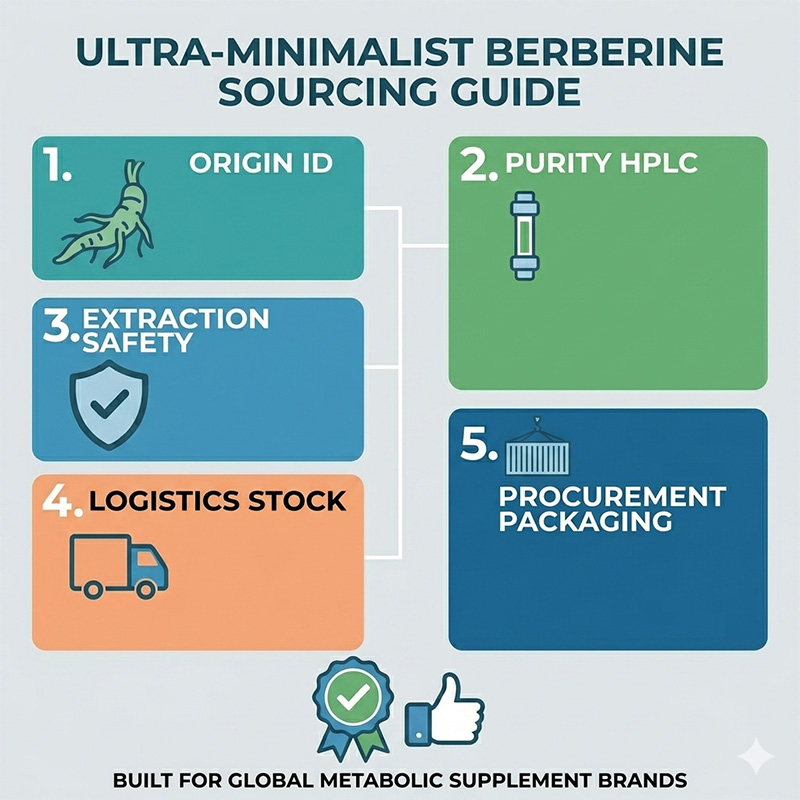
The global berberine supplement market is projected at USD 680 million in 2026, growing at a CAGR of 9.4%. Often called “nature’s Ozempic,” berberine has become one of the most clinically researched botanical ingredients in the supplement industry. This guide covers sourcing, formulation, and regulatory considerations for B2B buyers.
What Is Berberine?
Berberine is an isoquinoline alkaloid found in Berberis aristata (barberry), Coptis chinensis (goldthread), and Hydrastis canadensis (goldenseal). The commercial standard is berberine HCl — a purified, standardized form (>=97% HPLC purity) used in all clinical studies.
Mechanism: Berberine activates AMPK (“metabolic master switch”), enhancing glucose uptake in muscle cells, suppressing liver glucose production, improving insulin sensitivity, and supporting healthy lipid profiles.
Why berberine HCl: Whole herb powders contain only 1-5% berberine — unreliable dosing. Clinical-positioned products require berberine HCl at >=97% purity.
Clinical Evidence for Metabolic Health
Blood Glucose Regulation: A 3-month RCT (n=116) comparing berberine (1,500mg/day) with metformin found comparable HbA1c reduction (-0.9% berberine vs. -1.0% metformin). A meta-analysis of 14 RCTs confirmed significant reductions in fasting blood glucose and HbA1c.
Lipid Profile: Berberine reduces LDL cholesterol by approximately 25% and triglycerides by 35% (meta-analysis of 27 studies), primarily through PCSK9 inhibition — the same mechanism targeted by prescription PCSK9 inhibitor drugs.
Gut Microbiome: Emerging research shows berberine promotes Akkermansia muciniphila — a bacterium associated with metabolic health and insulin sensitivity — opening formulation opportunities for berberine + probiotic combinations.
Anti-Inflammatory: CRP reduced 32% in metabolic syndrome patients via NF-kappaB pathway inhibition.
2026 Market Trends
Top-selling categories: Blood sugar support complexes (47%), GLP-1 companion supplements (23% — *regulatory caution advised*), metabolic syndrome formulas (18%), gut health stacks (12%).
Dosage: Clinical studies use 900-1,500mg/day in divided doses. Consumer products typically deliver 500-1,200mg/day.
Bioavailability challenge: Oral berberine has approximately 0.5% bioavailability. Liposomal berberine achieves 2-3x higher absorption; phytosome technology achieves approximately 2x; sublingual delivery bypasses first-pass metabolism.
Best-selling stacks: Berberine + Chromium (enhanced glucose uptake); Berberine + Alpha Lipoic Acid (mitochondrial support); Berberine + Milk Thistle (liver protection); Berberine + Probiotics (gut-metabolic axis).
Raw Material Specifications
| Source | Berberine Content | Price (2026) | Primary Market |
| Berberis aristata (India/Himalayan) | 3-5% raw | USD 180-320/kg | EU brands |
| Coptis chinensis (China) | 5-10% raw | USD 150-280/kg | US brands |
Both produce equivalent berberine HCl at >=97% purity when standardized.
Key CoA specs: HPLC assay >=97%, loss on drying <=5%, heavy metals (Pb <=10ppm, As <=3ppm, Cd <=1ppm, Hg <=0.1ppm), residual solvents (ICH Q3C compliant), microbial (USP <61>/<62>).
Regulatory Notes (US & EU)
United States (FDA): Berberine is a dietary ingredient (21 CFR Part 190) — no pre-market approval required.
Allowed: *”Supports healthy blood glucose levels already within normal range.”*
NOT allowed: *”Treats diabetes,” “Lowers blood sugar,” “Replaces medication.”*
Drug interactions (required label warning): May interact with metformin, cyclosporine, and blood thinners.
European Union (EFSA): Berberis aristata extract is approved as a food supplement ingredient (no Novel Food authorization required at current levels).
B2B Sourcing Checklist
– [ ] GMP/cGMP certified facility
– [ ] HPLC purity >=97% with batch-specific CoA
– [ ] ISO 17025 third-party lab testing
– [ ] Residual nicotinamide test <=0.1%
– [ ] 24-month stability data
– [ ] Sample available before production order
– [ ] Country of origin disclosed