










How to Choose a Creatine Monohydrate Supplier: 8 Quality Checks Before You Order (With a Real COA Example)
On a product label, every creatine monohydrate looks the same: “100% creatine monohydrate, 5 g per serving.” The difference between a high-quality and a low-quality product is invisible until you read the Certificate of Analysis (COA) and ask the right questions about how it was made.
This guide is for supplement brands, private label buyers and distributors. It explains what to check on a creatine COA, which numbers matter, and the questions to ask before you place an order.
Key Takeaways
- Ask for a batch-specific COA, not a generic specification sheet.
- The key numbers are assay (purity) by HPLC, creatinine, dicyandiamide (DCD), heavy metals and microbiology.
- Particle size (mesh) affects how well the powder mixes. 200 mesh is the common micronized standard.
- Check the factory’s GMP certification, not only the raw material.
- Always test a sample and match its lot number to the COA.
Why Creatine Quality Varies
Creatine monohydrate is made by chemical synthesis. Commercially, it is most often produced from sarcosine and cyanamide. When the process or purification is poorly controlled, several by-products can remain in the final powder:
- Creatinine: a breakdown product of creatine, which increases with poor processing or storage
- Dicyandiamide (DCD): a by-product linked to the cyanamide raw material
- Dihydrotriazine (DHT): another possible synthesis by-product
A reliable supplier controls these impurities and reports them on the COA.
Example: What a Good Creatine COA Looks Like
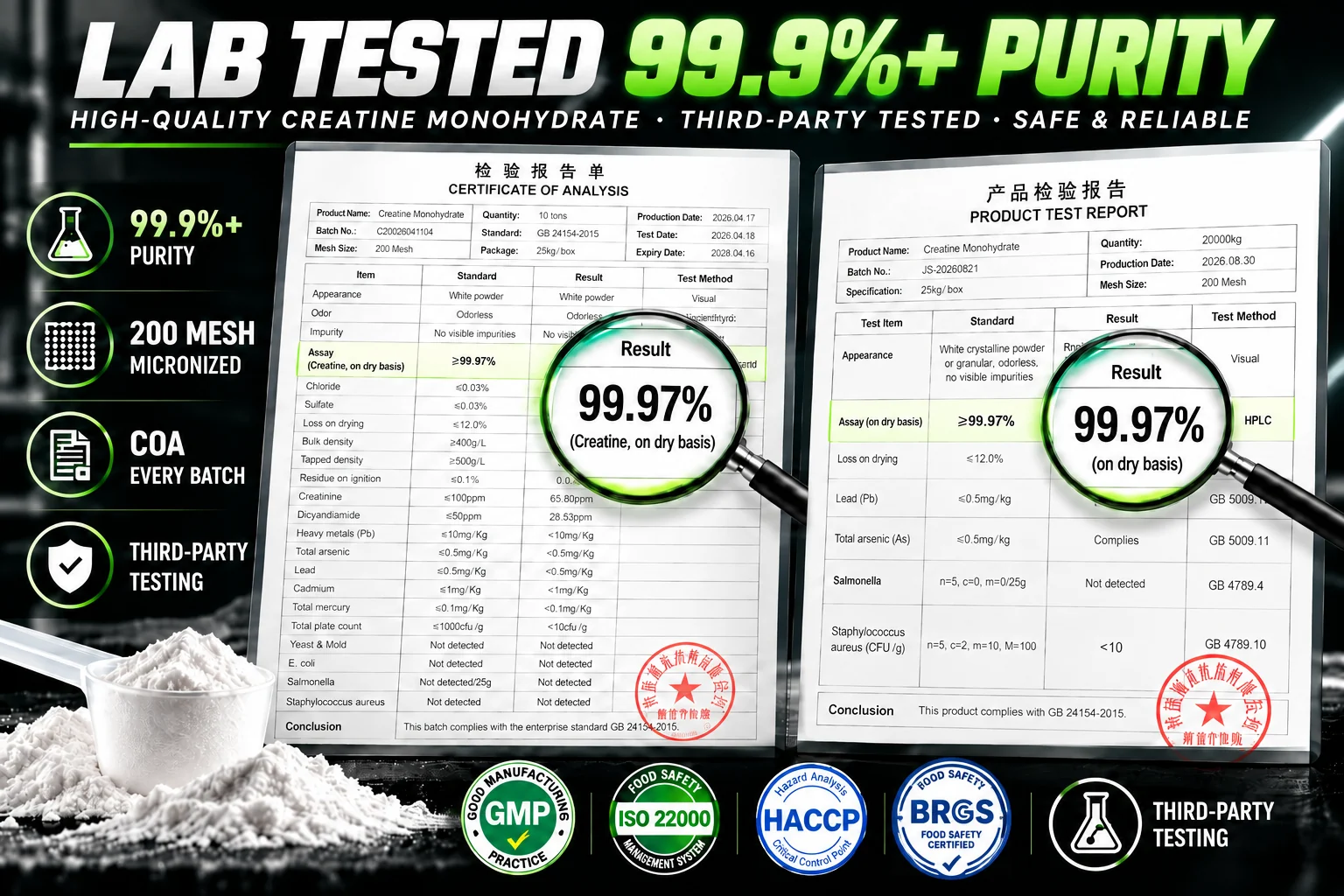
The table below shows the specification and actual results from one of our recent creatine monohydrate batches:
| Test item | Specification | Batch result |
|---|---|---|
| Assay (creatine, dry basis) | ≥ 99.97% | 99.97% |
| Creatinine | ≤ 100 ppm | 65.80 ppm |
| Dicyandiamide (DCD) | ≤ 50 ppm | 28.53 ppm |
| Loss on drying | ≤ 12.0% | Complies |
| Lead (Pb) | ≤ 0.5 mg/kg | < 0.5 mg/kg |
| Total arsenic | ≤ 0.5 mg/kg | < 0.5 mg/kg |
| Cadmium | ≤ 1 mg/kg | < 1 mg/kg |
| Total mercury | ≤ 0.1 mg/kg | < 0.1 mg/kg |
| Total plate count | ≤ 1,000 cfu/g | < 10 cfu/g |
| Yeast & mold, E. coli, Salmonella, S. aureus | Not detected | Not detected |
| Particle size | 200 mesh | Complies |
Use it as a reference when you compare suppliers.
The 8 Checks
1. Assay (purity) measured by HPLC
Look for ≥ 99.5%, ideally ≥ 99.9%, measured by HPLC and reported on a dry basis. If the COA shows a purity number without a method, ask how it was tested.
2. Creatinine
Creatinine shows how well the creatine was processed and stored. A typical high-quality limit is ≤ 100 ppm. Higher values can point to degradation.
3. Dicyandiamide (DCD), and ask about DHT
DCD is one of the most important impurities to check on creatine. Ask for a numerical result, not just “complies”. Many quality buyers also ask whether dihydrotriazine (DHT) is tested, and how.
4. Heavy metals
Ask for individual results for lead, arsenic, cadmium and mercury, not one combined “heavy metals” number. Your target market’s limits may differ, so check them before ordering.
5. Microbiology
Total plate count, yeast and mold, E. coli, Salmonella and S. aureus should be on the COA. Creatine is a dry powder, so results should be very low or not detected.
6. Particle size and loss on drying
200 mesh micronized powder mixes much better in water and shakes than standard powder, which matters for customer reviews. Loss on drying around 12% is normal for creatine monohydrate, because the molecule contains bound water. Very different values deserve a question.
7. Factory certification, not just raw-material paperwork
The COA tells you about the powder. The factory’s GMP certification tells you how it is blended, filled, labeled and documented. Look for a dietary-supplement GMP certification such as NSF/ANSI 455-2, plus food-safety systems such as FSSC 22000, BRCGS, HACCP. Ask to see the certificates.
8. A COA for every batch, and a sample you can test
Make sure every commercial batch ships with its own COA, and that the lot number on the COA matches the lot number on your product. Before your first order, test a sample yourself:
- Mix 5 g in a glass of water. It should disperse easily, without gritty residue.
- Check the color and smell: white, odorless powder.
- Match the sample’s lot number to its COA.
- If your retailer or market requires it, send the sample to an independent lab for extra testing.
Red Flags When Choosing a Creatine Supplier
- The supplier only sends a generic specification sheet, never a batch COA.
- The COA shows purity without a test method.
- No numerical results for creatinine or DCD.
- Heavy metals reported as one combined number only.
- The supplier cannot show factory GMP certificates.
- The price is far below the market with no explanation.
Questions to Ask Before You Order (Copy and Paste)
- Can you send a batch-specific COA for your current creatine lot?
- Which method do you use for the assay, and is it on a dry basis?
- What are your limits and actual results for creatinine and DCD? Do you test DHT?
- What particle size (mesh) do you supply?
- Which GMP and food-safety certifications does your factory hold? Can I see them?
- Will every commercial batch ship with its own COA?
- Can I get a sample from the same lot as my production?
- What is the shelf life and the recommended storage?
Frequently Asked Questions
What purity should creatine monohydrate have?
Look for at least 99.5%, ideally 99.9% or higher, measured by HPLC on a dry basis.
What is DCD in creatine?
Dicyandiamide (DCD) is a by-product that can remain from creatine synthesis. Quality suppliers keep it low and report a numerical result on the COA.
Is 200 mesh creatine better?
For powders, yes in practice: 200 mesh micronized creatine disperses more easily in water than coarser powder, which improves the customer experience.
Does creatine from China meet US quality standards?
Origin alone does not decide quality. What matters is the batch COA, the impurity results and the factory’s GMP certification. Ask for all three from any supplier, in any country.
Should every batch have its own COA?
Yes. A COA should match the specific lot you receive, not a previous batch or a generic specification.
Work With a Creatine Manufacturer That Shows Its Numbers
We manufacture private label creatine monohydrate at our group’s NSF/ANSI 455-2 GMP-certified facilities, with a COA for every batch and a free sample before you order.
Related reading: Creatine Gummies Manufacturing: How to Get a Real 5 g Dose | Women's Creatine Private Label: How to Launch a Creatine for Women
These statements have not been evaluated by the Food and Drug Administration. This product is not intended to diagnose, treat, cure, or prevent any disease.