










The Rising Demand for Lion’s Mane: Why Affordable Contract Manufacturing Matters
The dietary supplement industry has witnessed a remarkable surge in consumer interest toward functional mushrooms, with Lion’s Mane (Hericium erinaceus) emerging as one of the most sought-after nootropic and cognitive support ingredients. For brand owners, retailers, and entrepreneurs looking to enter this expanding market, understanding the landscape of affordable custom lions mane mushroom supplement contract manufacturing has become essential for building a competitive product line while maintaining healthy profit margins.
The global nootropics market, within which Lion’s Mane supplements represent a significant and rapidly growing segment, is projected to reach approximately $6.1 billion by 2031, expanding at a compound annual growth rate (CAGR) of around 15.3% from 2024 to 2031. Within the broader functional mushroom market, Lion’s Mane commands a substantial share due to its unique bioactive profile and growing body of scientific research supporting its cognitive and neurological benefits. Industry analysts estimate that the functional mushroom supplement sector alone will surpass $19.3 billion globally by 2030, with Lion’s Mane products representing one of the top three bestselling mushroom supplement categories across North American and European markets.
For businesses seeking to capitalize on this momentum, contract manufacturing offers a strategic pathway to product development without the prohibitive capital expenditure required to build and operate a GMP-compliant manufacturing facility. However, navigating the complexities of custom formulation, quality assurance, regulatory compliance, and cost optimization requires a thorough understanding of what professional OEM/ODM manufacturing partners can deliver.
This article examines the critical factors that brand owners must evaluate when selecting a contract manufacturing partner for Lion’s Mane mushroom supplements, explores the science underpinning this ingredient’s market appeal, analyzes current market trends and demand drivers, and provides practical guidance on formulation formats, quality standards, and manufacturing considerations that directly impact product success and affordability.
—
The Science Behind Lion’s Mane Mushroom: Mechanisms of Action and Bioactive Compounds
To develop a compelling and efficacious Lion’s Mane supplement, brand owners and formulators must understand the specific bioactive compounds that deliver the ingredient’s health benefits. Lion’s Mane mushroom contains two primary classes of bioactive molecules: hericenones and erinacines. Hericenones are found predominantly in the fungal fruiting body, while erinacines are concentrated in the mycelium. Both compound classes have demonstrated the ability to stimulate the production of nerve growth factor (NGF) in preclinical studies, which underpins the ingredient’s reputation for cognitive support and neurological health.
Research indicates that hericenones (specifically hericenones C, E, and D) and erinacines (particularly erinacine A) can cross the blood-brain barrier and promote neuronal health through multiple pathways. A 2008 double-blind, parallel-group, placebo-controlled trial published in Phytotherapy Research involving 30 older adults with mild cognitive impairment found that consumption of Lion’s Mane mushroom powder (approximately 2.5 grams three times daily, totaling 7.5 grams per day) for 16 weeks significantly increased cognitive scores compared to the placebo group. While these findings are promising, it is important to note that more large-scale, long-term human clinical trials are still needed to fully establish efficacy and optimal dosing parameters.
From a formulation perspective, the bioactive compound profile varies significantly depending on whether the product utilizes fruiting body extract, mycelium biomass, or a combination of both. Fruiting body extracts typically contain higher concentrations of beta-glucans (polysaccharides widely recognized for immune support) and hericenones, while mycelium-based ingredients are richer in erinacines. Reputable contract manufacturers offer standardized extracts with guaranteed minimum concentrations of beta-glucans (commonly 25% to 50%) and specific marker compounds, ensuring batch-to-batch consistency and label claim accuracy.
The extraction method also critically influences the bioavailability and potency of the final ingredient. Hot water extraction is the traditional method for isolating water-soluble beta-glucans, while ethanol or dual-extraction processes (combining hot water and ethanol extraction) are required to capture both water-soluble polysaccharides and alcohol-soluble compounds such as hericenones and erinacines. Contract manufacturers offering custom formulation services should be able to provide detailed certificates of analysis (COA) verifying the extraction method, standardized marker concentrations, and absence of contaminants including heavy metals, pesticides, and microbial pathogens.
When sourcing Lion’s Mane raw materials, brand owners should prioritize suppliers who can document the substrate on which the mushrooms were cultivated. Mushrooms are known to bioaccumulate heavy metals and environmental contaminants from their growth substrate, making substrate transparency a critical quality consideration. Premium manufacturers cultivate Lion’s Mane on organic-certified substrates such as hardwood sawdust or oat bran, and can provide organic certification documentation (USDA Organic, EU Organic) when required for label claims.
Understanding these scientific fundamentals enables brand owners to make informed decisions when working with contract manufacturers to develop custom Lion’s Mane formulations that deliver measurable value to end consumers, rather than simply competing on price with commoditized, low-bioactivity products.
—
Market Trends and Growing Demand: Data-Driven Insights for Brand Owners
The demand for Lion’s Mane mushroom supplements has accelerated dramatically over the past five years, driven by converging consumer trends including increased focus on cognitive health, rising interest in plant-based and fungal-derived nutraceuticals, and growing consumer sophistication regarding ingredient sourcing and standardization. Google Trends data indicates that search interest for “Lion’s Mane supplement” has increased by more than 400% between 2019 and 2024 in the United States, with particularly strong growth in the 25-45 demographic.
E-commerce analytics from major supplement retailers and Amazon sales data reveal that Lion’s Mane products consistently rank among the top-selling nootropic supplements, with customer reviews frequently citing benefits related to focus, mental clarity, and productivity. The appeal spans multiple consumer segments: working professionals seeking cognitive support, students looking for focus and concentration aids, and aging consumers interested in healthy aging and neurological wellness.
Geographically, North America represents the largest regional market for Lion’s Mane supplements, followed by Europe and the Asia-Pacific region. In the United States, the dietary supplement market’s increasing adoption of functional mushrooms has been facilitated by the growing acceptance of adaptogens and nootropics as mainstream wellness categories. Consumer survey data suggests that approximately 42% of regular dietary supplement users in the U.S. have tried a mushroom-based supplement, with Lion’s Mane being the most frequently purchased variety.
The competitive landscape for Lion’s Mane supplements has also evolved. Five years ago, the market was dominated by a small number of specialty brands with premium pricing. Today, the category includes products across a wide price spectrum, from entry-level powder formulations to premium, clinically-dosed capsule and gummy products with additional nootropic ingredients such as Bacopa monnieri, Ginkgo biloba, or vitamin B12. This broadening of the market creates both opportunities and challenges for new brand owners entering the space through contract manufacturing partnerships.
One significant trend influencing contract manufacturing requirements is the growing consumer preference for clean-label products. Buyers increasingly scrutinize ingredient decks for artificial additives, fillers, and unnecessary excipients. This has driven demand for clean-label Lion’s Mane formulations featuring simple, recognizable ingredient lists, vegan-friendly capsules (pullulan or cellulose rather than gelatin), and natural flavor systems for gummy or powder formats. Contract manufacturers with expertise in clean-label formulation are better positioned to support brand owners targeting discerning consumer segments willing to pay a premium for transparency and quality.
Another notable market dynamic is the rise of subscription-based direct-to-consumer (DTC) models for supplement brands. The recurring revenue characteristics of subscription models have motivated many entrepreneurs to launch Lion’s Mane supplement brands with customized formulations and branded packaging produced through OEM/ODM manufacturing partnerships. For these businesses, finding a contract manufacturer that offers low minimum order quantities (MOQs), flexible packaging options, and rapid turnaround times is essential for testing market response and iterating product formulations without excessive inventory risk.
Understanding these market trends enables brand owners to make strategic decisions about product positioning, formulation investment, and manufacturing partnerships that align with realistic market opportunities and competitive dynamics.
—
Key Manufacturing Considerations for Custom Lion’s Mane Formulations
Developing a custom Lion’s Mane mushroom supplement requires careful attention to multiple manufacturing variables that influence product quality, stability, bioavailability, and cost. One of the most fundamental decisions is selecting the appropriate raw material specification: fruiting body powder, fruiting body extract, mycelium biomass, or a blended formulation combining both fruiting body and mycelium extracts.
Each raw material type carries different cost implications and bioactive profiles. Fruiting body extracts with standardized beta-glucan content (typically 30% to 50%) command higher prices than plain fruiting body powder but deliver superior potency and consistency. Mycelium biomass on grain substrate is generally less expensive but may contain fillers such as residual grain starch, which dilutes the effective bioactive concentration. Sophisticated contract manufacturers can guide brand owners through these trade-offs, helping to balance desired product efficacy with target price points and retail positioning.
Stability and shelf life represent additional formulation challenges specific to Lion’s Mane ingredients. The bioactive compounds in Lion’s Mane, particularly the erinacines, are sensitive to heat, light, and oxygen exposure. Improper handling during manufacturing or inadequate packaging can lead to degradation of these compounds over the product’s shelf life, potentially compromising efficacy and exposing the brand to consumer dissatisfaction. Professional contract manufacturers address these challenges through multiple strategies: conducting accelerated stability studies to determine shelf life parameters, utilizing nitrogen flushing or oxygen absorbers in packaging, selecting appropriate container materials (amber PET or glass for light-sensitive formulations), and maintaining strict temperature and humidity controls in storage and production areas.
Bioavailability enhancement is another important consideration in custom formulation. While Lion’s Mane extracts are generally well-absorbed, certain formulation strategies can further optimize bioavailability. For capsule and tablet formats, the inclusion of bioperine (black pepper extract standardized to piperine) or other bioavailability enhancers may be considered, though brand owners should evaluate the scientific support and cost implications of such additions. For gummy formulations, the water activity level and pH must be carefully controlled to maintain the stability of Lion’s Mane extracts, as some bioactive compounds may degrade in acidic or high-moisture environments over time.
Taste masking presents a particular challenge for Lion’s Mane supplement formats that are consumed directly, such as powders and gummies. Lion’s Mane extracts have a distinctive earthy, umami flavor that some consumers find unpleasant. In powder formulations, natural flavor systems (such as cocoa powder, matcha, or tropical fruit flavors) can effectively mask the mushroom taste. Gummy formulations require more sophisticated flavor masking, often involving layered flavor systems combining natural fruit flavors, citric acid, and sweetener blends. Experienced contract manufacturers have established flavor libraries and formulation expertise specifically for mushroom-based products and can significantly reduce the trial-and-error time required to achieve a palatable final product.
Cost optimization in custom manufacturing is achieved through multiple levers: raw material sourcing efficiency, formulation concentration strategy (balancing potency with serving size), packaging selection, and order volume. Brand owners working with transparent contract manufacturing partners can explore these variables collaboratively to arrive at a formulation and packaging configuration that meets quality and efficacy targets while remaining within budget constraints. It is worth emphasizing that the lowest-cost manufacturing option is rarely the most economical in the long term if quality shortcomings lead to customer returns, negative reviews, or regulatory issues.
—
OEM/ODM Contract Manufacturing: Strategic Benefits for Brand Owners
Outsourcing supplement manufacturing to an experienced OEM/ODM partner offers numerous strategic advantages for brand owners, particularly those seeking to enter the Lion’s Mane supplement market with limited capital resources or without in-house manufacturing expertise. Understanding these benefits is essential for making an informed decision about whether contract manufacturing aligns with your business model and growth objectives.
Lower Barriers to Entry and Reduced Capital Expenditure
Establishing a GMP-compliant supplement manufacturing facility requires substantial upfront investment, typically ranging from $500,000 to several million dollars depending on the facility scale, equipment requirements, and regulatory certifications pursued. For most emerging supplement brands, this level of capital expenditure is neither feasible nor strategically desirable. Contract manufacturing eliminates the need for facility investment, allowing brand owners to allocate limited capital toward brand development, marketing, customer acquisition, and inventory management.
Access to Formulation Expertise and Established Supply Chains
Reputable contract manufacturers employ experienced formulators, chemists, and quality assurance professionals who understand the technical nuances of supplement manufacturing. By leveraging this expertise, brand owners can avoid common formulation pitfalls and accelerate product development timelines. Additionally, established manufacturers have pre-negotiated relationships with raw material suppliers, enabling them to source high-quality Lion’s Mane extracts and other ingredients at more favorable pricing than a brand owner could negotiate independently, particularly at low order volumes.
Low Minimum Order Quantities (MOQs) and Scalability
One of the most significant advantages of modern contract manufacturing is the availability of low MOQ options, which allow emerging brands to test market response with minimal inventory risk. Depending on the formulation format and packaging selection, some manufacturers offer MOQs as low as 500 to 1,000 units for private label or lightly customized formulations, while fully custom formulations may require MOQs of 3,000 to 5,000 units or more. As the brand grows and order volumes increase, the per-unit manufacturing cost typically decreases, improving gross margins and enabling more competitive retail pricing or higher profitability.
Speed to Market
Developing a supplement product from concept to retail-ready inventory can take anywhere from 3 to 12 months when managing the process independently. Contract manufacturers with established processes, in-stock raw materials, and available production slots can often reduce this timeline to 8 to 16 weeks for standard formulations, and 12 to 20 weeks for complex custom formulations requiring flavor development or specialized packaging. For brands targeting time-sensitive market opportunities or seasonal sales windows, this accelerated timeline can be a decisive competitive advantage.
Regulatory Compliance and Documentation Support
Dietary supplement manufacturing is subject to extensive regulatory requirements, including current Good Manufacturing Practices (cGMPs) under 21 CFR Part 111 in the United States, label compliance with FDA regulations, and, where applicable, international regulations for export markets. Contract manufacturers certified to these standards assume responsibility for production-phase compliance, providing documentation such as batch records, certificates of analysis, and stability data that support the brand owner’s regulatory posture. While the brand owner retains ultimate responsibility for product compliance, working with a certified contract manufacturer significantly reduces regulatory risk and administrative burden.
Customization and White-Label Flexibility
Contract manufacturing spans a spectrum from simple white-label arrangements (where the brand owner selects from pre-developed formulations with custom labeling) to fully custom formulation development. For Lion’s Mane supplements, customization options may include proprietary ingredient blends (e.g., Lion’s Mane + Cordyceps + Reishi for a comprehensive mushroom formula), custom dosage strengths, unique delivery formats (such as gummies with targeted flavor profiles), and specialized packaging (such as compostable pouches or premium glass jars with tamper-evident seals). The degree of customization desired will influence cost, MOQ requirements, and development timeline, all of which should be evaluated in the context of the brand’s positioning and target market.
—
Quality Assurance and Certification Standards in Lion’s Mane Contract Manufacturing
Quality assurance is the cornerstone of reputable contract manufacturing and a critical differentiation factor when selecting a manufacturing partner. For Lion’s Mane mushroom supplements, which are consumed for their health benefits, any compromise in quality can have serious implications for consumer safety, brand reputation, and regulatory compliance. Brand owners must thoroughly evaluate the quality systems and certifications maintained by prospective contract manufacturing partners.
GMP Certification and Third-Party Audits
Current Good Manufacturing Practices (GMP) certification is the foundational quality standard for dietary supplement manufacturing. In the United States, FDA-regulated facilities must comply with 21 CFR Part 111, and many manufacturers voluntarily pursue third-party GMP certification through organizations such as NSF International, NPA (Natural Products Association), or SGS. Third-party certification provides independent verification that the facility’s quality systems, documentation practices, personnel training, and production controls meet or exceed regulatory requirements. When evaluating contract manufacturers, brand owners should request copies of current GMP certificates and, where possible, review the scope of certification to confirm it covers the specific manufacturing activities (e.g., capsule filling, gummy production, powder blending) relevant to the intended product.
Ingredient Testing and Certificates of Analysis (COA)
A robust quality assurance program includes testing at multiple stages: incoming raw material verification, in-process testing during manufacturing, and finished product analysis prior to release. For Lion’s Mane raw materials, critical testing parameters include identity verification (through macroscopic, microscopic, or DNA-based methods), beta-glucan content (via validated analytical methods such as Megazyme assay), heavy metals (lead, arsenic, cadmium, mercury), microbial contamination (total plate count, yeast and mold, E. coli, Salmonella, Staphylococcus aureus), and pesticide residue screening.
Reputable contract manufacturers provide a certificate of analysis for each finished product batch, documenting that the product meets established specifications for identity, purity, strength, and composition. Brand owners should review sample COAs from prospective manufacturers to assess the completeness and clarity of the documentation provided. COAs should be issued by an ISO 17025-accredited laboratory, either the manufacturer’s in-house lab (if properly accredited) or a third-party analytical laboratory.
Stability Testing and Shelf Life Determination
As noted previously, the bioactive compounds in Lion’s Mane are susceptible to degradation under adverse storage conditions. Contract manufacturers offering comprehensive quality services should conduct stability studies on finished products to establish documented shelf life claims. Accelerated stability testing (typically 3 to 6 months under elevated temperature and humidity conditions) and real-time stability testing provide data to support expiration dating and storage condition recommendations. Brand owners should confirm that their contract manufacturing partner has the capability to conduct or coordinate these studies and is willing to provide stability data to support label claims.
Additional Certifications: Organic, Non-GMO, Halal, Vegan
Depending on the target market and brand positioning, additional third-party certifications may be required or advantageous. USDA Organic and EU Organic certifications require that all ingredients, processing aids, and manufacturing processes meet organic standards, including restrictions on synthetic pesticides, fertilizers, and processing aids. Non-GMO Project verification confirms that the product does not contain genetically modified organisms. Halal certification ensures compliance with Islamic dietary law, which can be important for accessing certain consumer segments. Vegan certification (such as the Vegan Action logo) verifies that the product contains no animal-derived ingredients and that manufacturing processes avoid cross-contamination with animal products. Contract manufacturers holding these certifications can streamline the certification process for brand owners and reduce the complexity of managing multiple certification bodies.
Traceability and Recall Preparedness
Effective quality systems include robust traceability protocols enabling the manufacturer to trace any finished product batch back to its constituent raw material lots and forward to specific customer shipments. In the event of a quality issue or potential safety concern, this traceability capability is essential for executing a targeted and efficient recall. Brand owners should inquire about the traceability systems employed by prospective contract manufacturers and confirm that they maintain complete batch records and distribution records for all produced lots.
—
Choosing the Right Delivery Format: Gummies, Capsules, Powders, and Beyond
The delivery format selected for a Lion’s Mane supplement significantly influences consumer appeal, manufacturing cost, formulation complexity, and shelf stability. Contract manufacturers typically offer multiple format options, and the optimal choice depends on the target consumer profile, price positioning, desired dosage form, and brand differentiation strategy.
Gummy Formulations
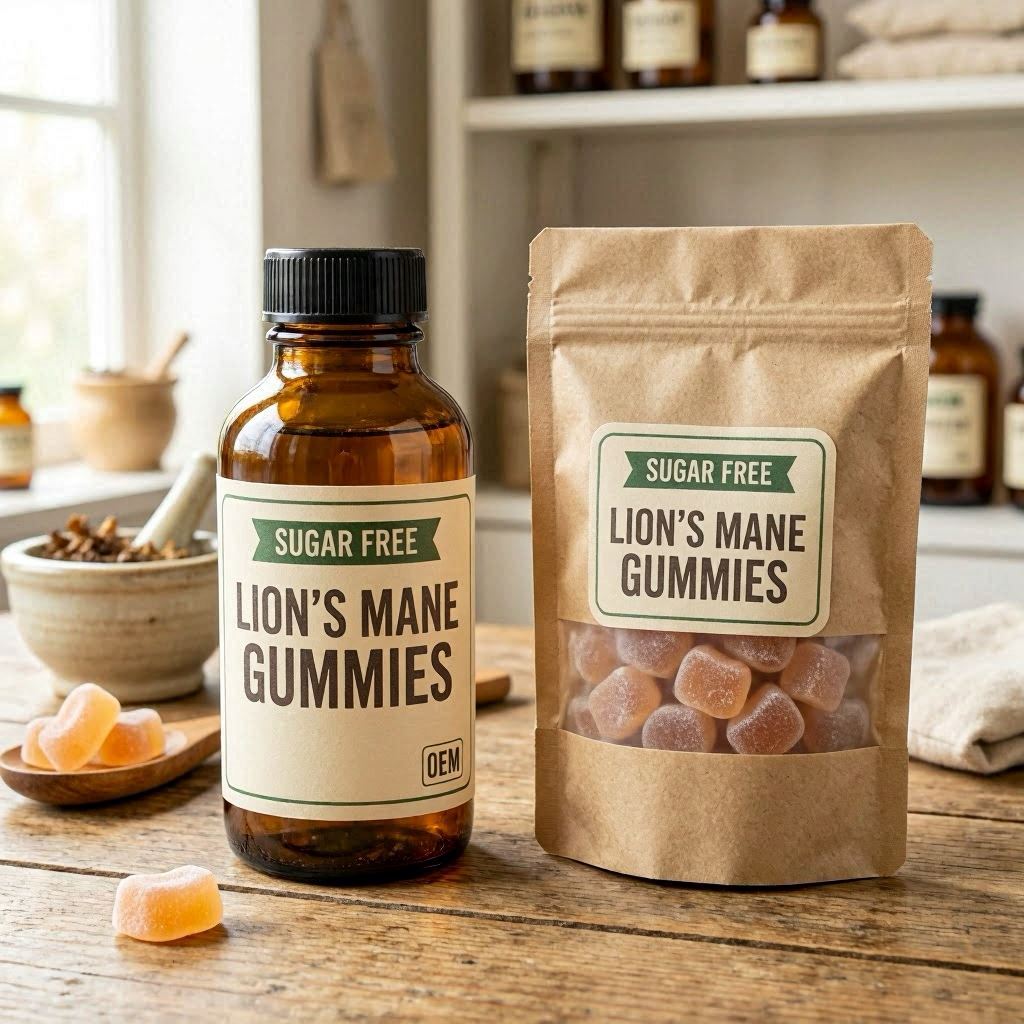
Gummies have experienced explosive growth in the dietary supplement industry, driven by consumer preference for palatable, convenient, and visually appealing supplement formats. For Lion’s Mane supplements, gummies offer several advantages: improved consumer compliance (particularly among demographics that dislike swallowing capsules), opportunities for distinctive branding through shape and color customization, and the ability to incorporate complementary ingredients in a single dose. However, gummy manufacturing presents unique formulation challenges. The water activity in gummies must be carefully controlled to prevent microbial growth and maintain the stability of water-sensitive ingredients like Lion’s Mane extracts. Additionally, achieving effective dosing in a gummy format can be challenging, as the extract must be incorporated at a meaningful potency within the constraints of gummy size and acceptable taste. Typical Lion’s Mane gummy formulations provide 250 mg to 500 mg of Lion’s Mane extract per gummy, often requiring two to four gummies per daily serving to achieve a therapeutically relevant dose.
From a cost perspective, gummies typically carry higher per-unit manufacturing costs than capsules or powders due to the more complex production process, flavor and texture optimization requirements, and specialized packaging needs (typically jars or pouches with moisture-barrier properties). However, the premium consumer perception and higher retail price tolerance for gummy supplements can offset these higher manufacturing costs and support attractive gross margins.
Capsule Formulations
Capsules remain the most widely used delivery format for Lion’s Mane supplements, offering a familiar, convenient, and cost-effective option. Two-piece hard capsules are available in multiple material options: gelatin (animal-derived, less expensive), bovine gelatin (Halal-certified options available), vegetarian cellulose (HPMC), and pullulan (plant-based, premium positioning). For Lion’s Mane extracts, capsules provide excellent protection from moisture and oxygen when properly filled and packaged, supporting shelf stability of the bioactive compounds.
Capsule formulations offer straightforward dosing precision and can accommodate higher potency levels per serving compared to gummies. A typical Lion’s Mane capsule product might provide 500 mg to 1,000 mg of standardized extract per capsule, with a recommended serving size of one to two capsules daily. The earthy taste of Lion’s Mane extract is effectively masked by the capsule shell, eliminating the need for flavor system investment. Manufacturing costs for capsules are generally lower than gummies, making this format attractive for brands targeting value-conscious consumers or competing in price-sensitive market segments.
Powder Formulations
Powder formulations offer versatility and customization for consumers who prefer to mix supplements into beverages, smoothies, or food. Lion’s Mane powder products can be formulated as straight mushroom powder (whole fruiting body or extract powder), blended superfood powders combining Lion’s Mane with other functional mushrooms and adaptogens, or instant beverage mixes with natural flavors and sweeteners. The powder format allows for higher total daily dosing flexibility, as consumers can adjust the amount added to their beverage according to personal preference and tolerance.
However, powder formulations face taste and solubility challenges. Lion’s Mane powder has a distinctive flavor that may not be acceptable to all consumers in an unflavored format. Successful powder products typically incorporate natural flavor systems and may include solubility enhancers or flow agents to improve the mixing experience. Packaging for powder products must provide an effective moisture and oxygen barrier, commonly utilizing foil-laminated pouches with resealable zippers or induction-sealed jars. Manufacturing costs for powders are generally competitive, though flavored and blended powder formulations require additional processing steps and quality controls.
Tablet Formulations
While less common for Lion’s Mane supplements than capsules or gummies, tablet formats offer certain advantages including compactness, lower packaging volume, and the ability to achieve high potency per tablet through compression. Tablet manufacturing requires specialized equipment and may involve challenges related to ingredient compressibility and disintegration time. For Lion’s Mane extracts, which are often fibrous or irregular in particle size, pre-processing such as spray drying or granulation may be necessary to achieve satisfactory tablet compression characteristics. Brand owners considering tablets should discuss these technical requirements with their contract manufacturing partner early in the formulation process.
Emerging and Novel Formats
Innovation in supplement delivery formats continues to evolve, with newer options including ready-to-drink (RTD) beverages, functional shots, oral strips, and functional chocolates incorporating Lion’s Mane extract. These novel formats can provide significant differentiation in a crowded market but typically require specialized manufacturing capabilities and higher development investment. Contract manufacturers with diverse format capabilities can advise on the feasibility, cost implications, and manufacturing lead times associated with these innovative delivery systems.
—
Frequently Asked Questions About Lion’s Mane Contract Manufacturing
What is the typical minimum order quantity (MOQ) for custom Lion’s Mane supplement manufacturing?
Minimum order quantities vary significantly depending on the delivery format, level of customization, and packaging complexity. For private label or white-label Lion’s Mane capsules with standard labeling, MOQs may range from 500 to 2,000 bottles. For fully custom formulations—particularly gummies or specialized powder blends requiring unique flavor development—MOQs typically start at 3,000 to 10,000 units. Brand owners should discuss their volume expectations and growth projections with prospective manufacturers to identify partners whose MOQ structure aligns with their business model. Some manufacturers offer tiered pricing structures that reduce per-unit costs as order volumes increase, providing a clear pathway for margin improvement as the brand scales.
How long does it take to develop and manufacture a custom Lion’s Mane supplement from concept to finished product?
The timeline for custom supplement development depends on multiple factors: the complexity of the formulation, whether new flavor systems must be developed, the availability of raw materials, packaging customization requirements, and the manufacturer’s production schedule. For a private label product with minimal customization (selecting an existing formula and applying custom labeling), the timeline is typically 8 to 14 weeks from order confirmation to finished goods. For a fully custom formulation requiring developmental work, stability testing, and custom packaging procurement, the timeline may extend to 16 to 26 weeks. Brand owners should build buffer time into their launch planning and maintain open communication with their manufacturing partner regarding timeline expectations and critical path milestones.
What quality documentation should I expect from a contract manufacturer for Lion’s Mane supplements?
At minimum, a reputable contract manufacturer should provide a certificate of analysis (COA) for each batch of finished product, documenting testing results for identity, potency, microbial contamination, heavy metals, and any other parameters specified in the product specifications. Additional documentation may include a certificate of compliance, batch production records (upon request), stability study data, and Allergen statements or Non-GMO affidavits where applicable. For products intended for export, the manufacturer may also provide a certificate of free sale or health certificate. Brand owners should ensure that all quality documentation is clear, complete, and issued in a timely manner to support their own quality assurance records and any regulatory submissions.
How can I verify that the Lion’s Mane extract used in my supplement is accurately labeled and contains the claimed bioactive compounds?
Transparency in the supply chain begins with the raw material supplier and extends through the manufacturing process. Brand owners should request that their contract manufacturer provide the raw material specification sheet and certificate of analysis for the Lion’s Mane extract, showing the standardized content of beta-glucans or other marker compounds. Additionally, independent third-party testing of finished products by an ISO 17025-accredited laboratory provides an objective verification of label claims. Many brands now choose to conduct periodic random testing of their own products as a quality assurance best practice, and contract manufacturers should be cooperative with such verification testing rather than viewing it as adversarial.
What are the main factors that influence the cost of custom Lion’s Mane supplement manufacturing?
Manufacturing costs are influenced by raw material prices (which fluctuate based on harvest conditions, demand, and supply chain dynamics), order volume (higher volumes typically reduce per-unit costs), delivery format (gummies are generally more expensive to produce than capsules or powders), level of customization (custom flavor development and unique packaging increase costs), and certification requirements (organic, non-GMO, and other third-party certifications involve additional fees and administrative costs). Brand owners can work with their manufacturing partner to model different cost scenarios based on formulation adjustments, volume commitments, and packaging alternatives to identify the optimal configuration for their target retail price and margin requirements.
Are there labeling or regulatory considerations specific to Lion’s Mane mushroom supplements that I should be aware of?
In the United States, Lion’s Mane supplements are regulated as dietary supplements under the Federal Food, Drug, and Cosmetic Act. Label claims must comply with FDA requirements: structure/function claims (e.g., “supports cognitive health”) must be truthful and not misleading, and the brand owner must submit a notification to FDA within 30 days of first marketing a product with a new structure/function claim. Lion’s Mane is generally recognized as safe (GRAS) for use in food and dietary supplements, but brand owners should verify that their specific extract and dosage fall within accepted parameters. Additionally, organic claims require certification by a USDA-accredited certifying agent, and any “natural” claims should be evaluated for compliance with FDA and FTC guidance. International regulations vary; for example, the European Union has specific novel food requirements that may apply to certain mushroom extracts, and brand owners targeting international markets should consult with regulatory experts familiar with the relevant jurisdictions.
Can a contract manufacturer help with packaging design and procurement, or do I need to source packaging independently?
Many contract manufacturers offer turnkey services that include packaging design support, sourcing, and procurement, in addition to manufacturing. This can be particularly valuable for first-time brand owners who may not have established relationships with packaging suppliers. Manufacturers can advise on packaging formats that are compatible with their production lines, help ensure that packaging materials meet regulatory requirements (such as appropriate contact substance compliance for food-grade packaging), and often secure more favorable pricing on packaging due to their volume purchasing. However, brand owners who have specific packaging preferences or existing supplier relationships may choose to supply their own packaging materials, provided the materials meet the manufacturer’s specifications and are delivered on the agreed timeline.
—
Conclusion: Strategic Partnerships for Long-Term Success in the Lion’s Mane Market
The Lion’s Mane mushroom supplement category represents a compelling market opportunity for brand owners who can deliver high-quality, efficacious products that meet the evolving expectations of today’s discerning supplement consumers. Success in this competitive landscape requires more than simply sourcing a generic Lion’s Mane powder and placing it in a capsule. It demands a strategic approach to formulation, an uncompromising commitment to quality assurance, and a manufacturing partnership that aligns with your brand’s values, quality standards, and growth trajectory.
Affordable custom contract manufacturing is not synonymous with cutting corners on quality. Rather, it means leveraging the expertise, scale, and established supply chains of professional OEM/ODM manufacturing partners to bring a thoughtfully developed product to market efficiently and cost-effectively. By understanding the scientific foundations of Lion’s Mane bioactive compounds, carefully evaluating manufacturing quality systems and certifications, selecting the optimal delivery format for your target consumer, and maintaining rigorous oversight of label claims and quality documentation, brand owners can build a Lion’s Mane supplement brand that earns consumer trust and achieves sustainable growth.
As the market for functional mushroom supplements continues to expand, the brands that succeed will be those that prioritize transparency, invest in quality differentiation, and cultivate strong, collaborative relationships with manufacturing partners who view their success as a shared objective. Whether you are launching your first supplement product or expanding an existing brand portfolio, the insights and considerations outlined in this article provide a foundation for navigating the complex but rewarding world of Lion’s Mane mushroom supplement contract manufacturing.
Disclaimer: These statements have not been evaluated by the Food and Drug Administration. This product is not intended to diagnose, treat, cure, or prevent any disease. The information provided in this article is for educational and informational purposes only and does not constitute medical advice. Always consult with a qualified healthcare professional before starting any supplement regimen.