










Introduction
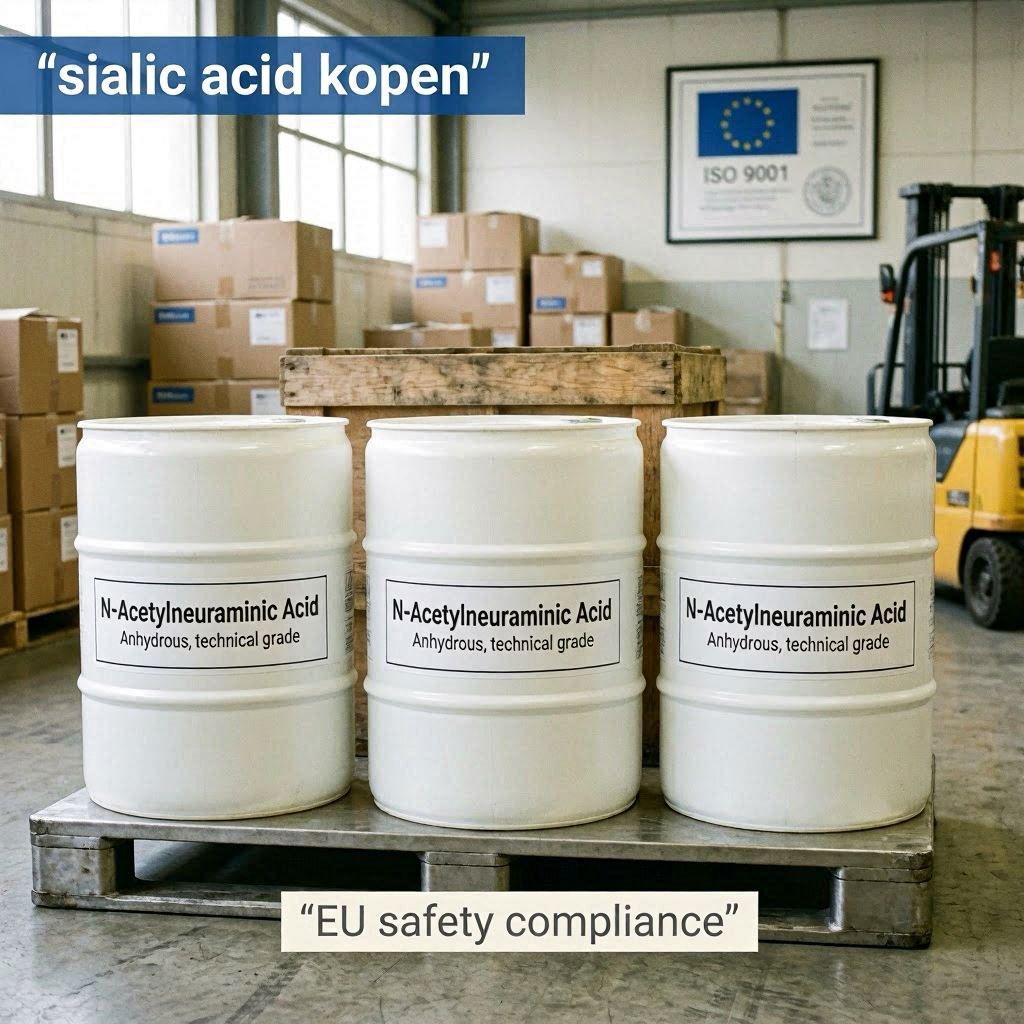
For premium nutraceutical brands, functional food developers, and cross-border e-commerce sellers targeting the European market, searching for a reliable partner to “sialic acid kopen” (buy sialic acid) represents a significant strategic expansion. Scientifically classified as N-Acetylneuraminic Acid (NANA), sialic acid is rapidly scaling from a traditional Asian luxury wellness ingredient into a global heavyweight within the cognitive health, infant nutrition, and cellular anti-aging sectors.
However, navigating the European regulatory landscape requires meticulous attention to ingredient compliance, novel food authorizations, and analytical verification. This technical brief outlines the core metabolic science, regulatory benchmarks, and critical B2B sourcing frameworks necessary to successfully launch a sialic acid product line in the EU and Western markets.
Neurological and Cellular Efficacy: The Science of N-Acetylneuraminic Acid
When creating marketing messaging or white-label collateral for professional supplement brands, the efficacy of Sialic Acid must be anchored strictly in cellular biology and validated biochemical actions.
Cognitive Development and Neuroprotection
Sialic acid is an essential structural component of brain gangliosides and glycoproteins. It plays an indispensable role in synaptogenesis—the formation of synapses between neurons—and is highly concentrated in the cerebral cortex.
Clinical data indicates that exogenous supplementation of N-Acetylneuraminic Acid supports cognitive longevity and neural plasticity. Unlike basic amino acids, Sialic Acid assists in maintaining the structural integrity of the myelin sheath, which optimizes signal transduction velocities across neural pathways.
Cellular Communication and Immune Modulation
At the cellular level, sialic acid molecules terminate the glycan chains expressed on cell surface membranes. This positioning makes them critical molecular “gatekeepers.” They regulate cell-to-cell recognition, mediate inflammatory responses, and prevent pathogens from binding to host cell receptors.
For nutricosmetic and beauty-from-within brands, Sialic Acid’s ability to promote epidermal glycoprotein synthesis makes it a highly sought-after functional ingredient for premium anti-aging formulations.
EU Regulatory Architecture: Novel Food Compliance and Safety Standards
When European brands look to source or “kopen” sialic acid, the primary hurdle is compliance with the European Food Safety Authority (EFSA). Under EU regulations, synthetic or fermentation-derived N-Acetylneuraminic Acid is categorized as a Novel Food under Regulation (EU) 2015/2283.
Strict Dosage Guidelines and Approved Food Categories
EFSA has established definitive safety thresholds and specific maximum usage levels for N-Acetylneuraminic Acid across distinct product categories. B2B brands must strictly design their formulations within these boundaries to ensure regulatory clearance:
- Dietary Supplements for Adults: Maximum approved dose is typically capped at 300 mg per day.
- Infant and Follow-on Formula: Requires ultra-high purity grades and strict adherence to localized mg/kg body weight calculations.
- Functional Dairy and Beverages: Subject to precise maximum incorporation limits per 100g of finished food matrix.
Manufacturing Origin and Purity Profiles
To comply with EU import mandates, bulk Sialic Acid must be produced via highly controlled microbial fermentation processes utilizing approved non-pathogenic strains (such as specific engineered lines of Escherichia coli). The raw material specification sheet must demonstrate an assay purity of $\ge$ 98.0% calculated on a dry basis, with zero detectable levels of residual solvents or bacterial endotoxins.
Industrial Sourcing Strategy and Quantitative Quality Control
Purchasing bulk raw materials for premium brands requires rigorous analytical validation to shield the supply chain from subpar active ingredient yields or contamination.
Analytical Validation Matrix
A robust Certificate of Analysis (COA) for bulk N-Acetylneuraminic Acid must contain the following verification benchmarks:
- Quantitative Assay: Determined by HPLC-UV or HPLC-MS, confirming a minimum purity threshold of 98.5%.
- Specific Optical Rotation: Evaluated between $-30.0^\circ$ to $-33.0^\circ$ to guarantee correct stereochemical orientation and isomer biological activity.
- Moisture Content (Karl Fischer Titration): Must be locked below $\le$ 1.0% to eliminate the risk of bacterial growth and hydrolytic degradation inside sealed containers during transit.
Formulation Stability in Powder and Liquid Deliveries
Sialic Acid exhibits excellent thermodynamic stability in solid-dose forms, making it ideal for standard hard-capsule and sachet powder applications. However, when formulating for liquid shots, functional carbonated drinks, or oral drop formats, product developers must strictly monitor the formulation’s pH matrix. N-Acetylneuraminic Acid is stable in mild acidities, but extreme thermal processing or alkaline formulations can cleave the glycosidic bonds, rendering the active molecule ineffective.
B2B Sourcing FAQ
Q1: What regulatory documentation must a manufacturer provide for Sialic Acid import into the EU?
The manufacturer must supply an EFSA-aligned Certificate of Analysis (COA) confirming $\ge$ 98% purity via HPLC, a detailed manufacturing flow chart detailing the fermentation process, a Halal/Kosher certificate if applicable, a comprehensive heavy metal and microbiological assay report, and a statement confirming the absence of residual solvents (complying with CPMP/ICH/283/95 guidelines).
Q2: Is Sialic Acid derived from natural bird’s nests acceptable for wide-scale European supplement distribution?
While bird’s nest extract is highly valued in Asian traditions, bulk commercial distribution in the EU primarily utilizes high-purity fermentation-derived N-Acetylneuraminic Acid. Fermentation-derived NANA offers significantly higher purity control, lower heavy metal risks, strict structural uniformity, and full alignment with vegan and clean-label market requirements.
Q3: What are the shelf-life parameters and optimal storage conditions for bulk Sialic Acid powder?
When stored in its original, unopened packaging—typically double-lined food-grade polyethylene bags inside fiber drums—bulk Sialic Acid powder has a verified shelf life of 24 to 36 months. It must be kept in a cool, dark, well-ventilated warehouse at temperatures below $25^\circ\text{C}$ and relative humidity below 50%.
Q4: Can N-Acetylneuraminic Acid be combined with other cognitive health ingredients?
Yes. Sialic acid exhibits excellent synergistic compatibility with other premium neuro-nutrients, such as Alpha-GPC, Phosphatidylserine (PS), Lion’s Mane Extract, and Coenzyme Q10. These combinations allow brands to claim multi-pathway cognitive support on their product labels while remaining within EFSA dosage limits.