










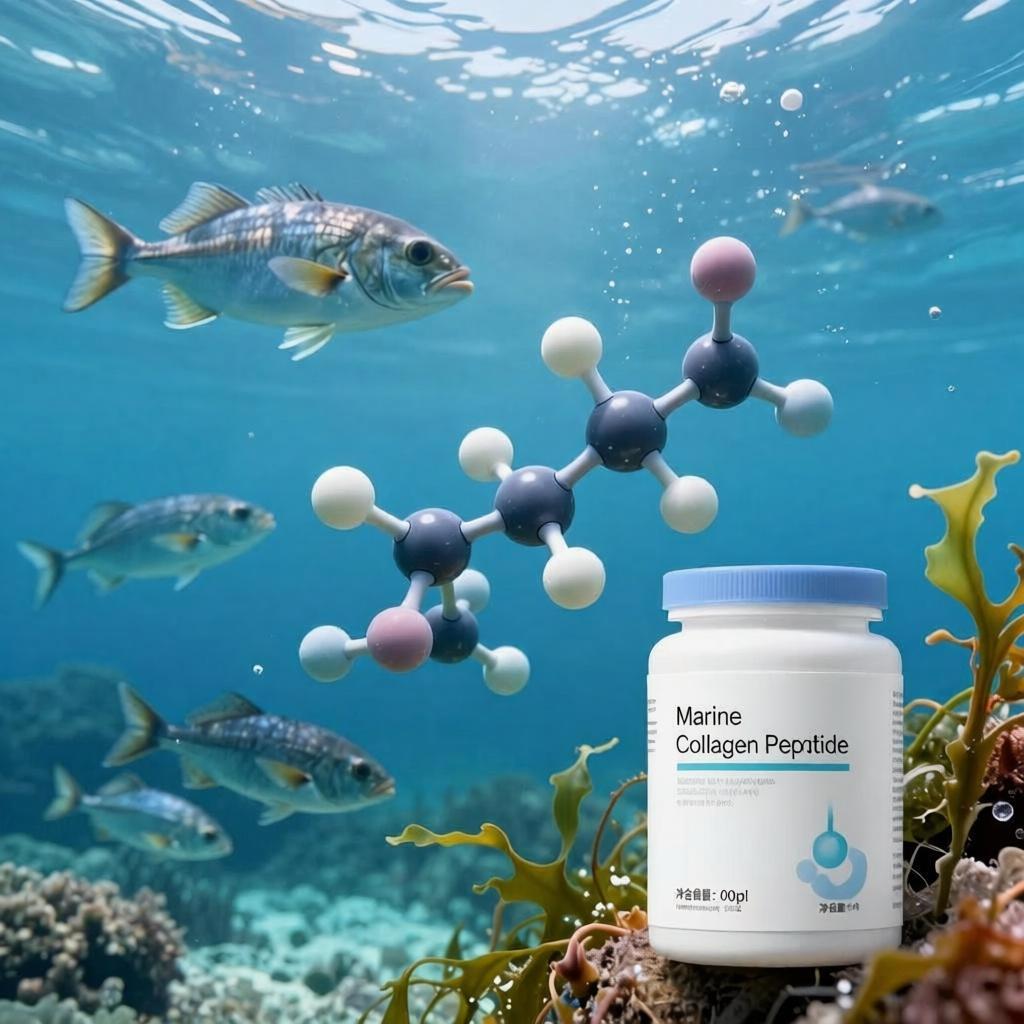
The Rise of Marine Collagen in a Crowded Peptide Market
Collagen is the most abundant protein in the human body, constituting the structural backbone of skin, cartilage, tendons, bones, and connective tissue. Beginning approximately in one’s mid-20s, endogenous collagen synthesis declines at a rate of roughly 1–1.5% per year — a trajectory that accelerates with UV exposure, chronic stress, poor sleep, and dietary insufficiency. This biological reality has created a multi-billion-dollar global supplement market, and within that market, marine-derived collagen peptides are emerging as the premium segment of choice for science-informed brands and health-conscious consumers.
The global marine collagen market was valued at approximately $1.26 billion in 2025 and is projected to reach $2.32 billion by 2032, posting a CAGR of around 9%. This growth rate meaningfully outpaces the broader collagen peptides market, reflecting several structural advantages that marine sources hold over conventional bovine and porcine alternatives.
What Makes Marine Collagen Peptides Distinctive
Marine collagen peptides are derived primarily from fish — most commonly from the skin, scales, fins, and bones, which are otherwise processing byproducts of the seafood industry. The use of these waste streams gives marine collagen a meaningful sustainability narrative: converting food industry residues into high-value functional ingredients. In addition to fish, emerging marine collagen sources include jellyfish and microalgae, which offer alternative supply chains for applications where halal, kosher, or vegan positioning is required.
Superior Bioavailability The most frequently cited advantage of marine collagen over bovine or porcine sources is bioavailability. Marine collagen peptides — produced through enzymatic hydrolysis to molecular weights typically below 5 kDa — are absorbed more rapidly and efficiently through the intestinal wall compared to intact collagen or higher-molecular-weight fragments. Studies utilizing stable isotope tracing have demonstrated that hydrolyzed marine collagen peptides appear in the bloodstream within 60 minutes of ingestion, with detectable accumulation in skin tissue within hours.
Predominantly Type I Collagen Marine sources — particularly fish skin and fins — yield predominantly Type I collagen, which is the dominant collagen type in human skin, tendons, and bones. This compositional alignment with human tissue collagen makes fish-derived peptides especially relevant for skin health, wound healing, and bone mineral density applications. The amino acid profile of marine collagen is rich in glycine, proline, and hydroxyproline — the same tripeptide motifs that stimulate fibroblast activity and extracellular matrix remodeling in human skin.
Religious and Ethical Positioning The absence of porcine or bovine origin allows marine collagen to serve Muslim and Jewish consumer markets (with appropriate halal/kosher certification), as well as consumers who avoid beef products for personal or cultural reasons. This broader market eligibility is a meaningful commercial advantage in global supplement distribution.
Clinical Evidence: What Does the Research Actually Support?
The evidence base for collagen peptide supplementation — particularly for skin and joint outcomes — has grown substantially over the past decade. Key findings include:
Skin Health A randomized, placebo-controlled study published in Skin Pharmacology and Physiology (2014) found that women who supplemented with 2.5g of hydrolyzed collagen peptides daily for 8 weeks showed a statistically significant improvement in skin elasticity compared to placebo, with effects persisting 4 weeks after supplementation ended. A 2019 meta-analysis in the Journal of Drugs in Dermatology reviewed 11 randomized controlled trials and concluded that oral collagen supplementation was associated with meaningful improvements in skin hydration, elasticity, and wrinkle depth.
The mechanism involves collagen peptide fragments (particularly the Pro-Hyp and Gly-Pro-Hyp dipeptides and tripeptides) acting as bioactive signals — binding to fibroblast receptors and upregulating endogenous collagen, hyaluronic acid, and elastin synthesis. This represents a different mode of action than simply “providing collagen building blocks,” and helps explain why low-dose supplementation (2.5–10g/day) can produce measurable dermal effects.
Joint and Bone Health Fish-derived collagen peptides containing Type I collagen have been investigated for their role in supporting cartilage matrix synthesis and joint comfort. A clinical study published in Current Medical Research and Opinion demonstrated that daily supplementation with collagen hydrolysate significantly reduced activity-related joint pain in athletes over 24 weeks compared to placebo. The proposed mechanism involves collagen peptides accumulating in joint cartilage and stimulating chondrocyte anabolic activity.
For bone health, collagen peptides have been studied in postmenopausal women — a population at elevated risk of osteoporosis — with results suggesting improvements in bone mineral density markers when combined with resistance training and adequate calcium/vitamin D intake.
Sports Nutrition & Muscle Recovery Marine collagen is increasingly positioned within sports nutrition, where it contributes to connective tissue support, injury prevention, and post-exercise recovery. A 2019 study in the American Journal of Clinical Nutrition found that collagen peptide supplementation combined with vitamin C and exercise significantly increased collagen synthesis markers and potentially reduced injury risk in athletes with connective tissue vulnerabilities. The muscle recovery application is particularly relevant for aging athletes, who experience slower tissue repair rates and greater connective tissue stress.
Important Regulatory Note When marketing collagen products in the US or EU, brands must be careful to frame benefits as structure/function claims (e.g., “supports healthy skin elasticity,” “helps maintain joint comfort”) rather than disease claims. The FDA and EFSA require substantiation for any specific health claim. The research referenced above is illustrative of the broader evidence base but should not be interpreted as regulatory approval of specific product claims.
Processing Technology: How Extraction Quality Shapes Product Performance
Not all marine collagen peptides are equivalent — and the differences matter significantly in both efficacy and consumer acceptability. Key production parameters include:
Enzymatic Hydrolysis High-quality marine collagen peptide production uses controlled enzymatic hydrolysis to achieve consistent low molecular weight distributions (typically 1,000–5,000 Daltons). The precision of this process determines peptide size distribution, which in turn affects absorption kinetics and bioactive peptide yield. Overly harsh processing conditions can degrade the bioactive tripeptide fractions that drive clinical effects.
Odor and Flavor Remediation One of the historically significant challenges with marine collagen has been the characteristic fishy odor, which limits palatability and formulation flexibility. Advanced deodorization technologies — including ozone oxidation, membrane filtration, and enzymatic debittering — have reduced off-flavor intensity by over 60% in leading production facilities, enabling marine collagen to be incorporated into neutral-tasting powders, ready-to-drink beverages, and food formats without compromising sensory experience.
Solubility and Formulation Versatility Premium marine collagen peptides are highly water-soluble and heat-stable, making them compatible with a wide range of delivery formats: powder sachets, capsules, tablets, functional beverages, protein bars, and beauty-from-within shot formats. The growing trend of collagen-enriched functional foods — from protein bars to collagen water — is made possible by the solubility and neutral flavor profile of well-processed marine peptides.
Market Trends and Competitive Landscape
Asia-Pacific Leads, North America Grows Rapidly Asia-Pacific accounts for approximately 41% of marine collagen market volume in 2024, driven by strong cultural alignment between collagen supplementation and beauty-from-within consumer culture in Japan, South Korea, and China. North America represents the largest revenue market at approximately 33%, with annual US market value projected to approach $470 million by 2032.
Recent significant market investments signal strong institutional confidence in the sector. In June 2025, Thai Union committed $30 million to a tuna-skin collagen facility producing 200 tonnes/year, targeting Japan, South Korea, and Australia. In February 2025, GNC launched a premium marine collagen product line with enhanced absorption properties, signaling continued mainstream retail entry. These investments reflect not just current demand, but anticipated growth in functional foods, sports nutrition, and clinical nutrition applications.
Sustainability as a Differentiator Consumer demand for traceable, sustainable ingredients is particularly acute in the marine collagen space given the ocean resource context. Brands and their manufacturing partners are increasingly required to demonstrate responsible sourcing practices: preferring wild-caught species with documented management plans, utilizing byproduct streams rather than whole fish, and providing third-party certification of sustainable practices. The “clean and green” sourcing narrative resonates particularly strongly with premium supplement consumers in North America and Europe.
Format Innovation The marine collagen supplement landscape is rapidly diversifying beyond traditional capsule and powder formats. Beauty-from-within shots (typically 5–10g collagen per 50ml serving), ready-to-mix collagen sticks, collagen-enriched coffee and tea blends, and even collagen-infused protein bars are now mainstream product categories. OEM/ODM manufacturers that can support multi-format production across powder, liquid, capsule, and bar formats are positioned to serve the broadest range of brand client needs.
Technical Specifications for B2B Sourcing
For supplement brands and formulators sourcing marine collagen peptides for product development, the following technical parameters should be specified and verified:
- Source documentation: Species name, country of origin, part of fish (skin, scales, fins), and wild-caught or aquaculture designation
- Molecular weight distribution: Confirmed by GPC (gel permeation chromatography), target range 1–5 kDa for optimal bioavailability
- Hydroxyproline content: A key marker for collagen authenticity and purity (typically >12% in quality marine collagen peptides)
- Protein content: ≥85–90% protein by weight (dry basis) for dietary supplement-grade material
- Heavy metals: Compliance with relevant pharmacopoeial or regulatory limits for arsenic, lead, mercury, and cadmium — particularly important for ocean-derived ingredients
- Microbiological testing: Total plate count, yeast and mold, Salmonella spp., Staphylococcus aureus
- Allergen declaration: Fish allergen labeling is required in the US (FDA FALCPA) and EU; cross-contamination controls must be documented
Conclusion: Marine Collagen’s Structural Advantages in a Growing Market
Marine collagen peptides occupy a unique position in the supplement ingredient landscape: scientifically substantiated, sustainability-aligned, religiously inclusive, and adaptable to a wide range of end formats and consumer demographics. The combination of growing clinical evidence, continued investment in processing technology, and accelerating mainstream consumer adoption positions marine-derived collagen as a high-value, high-growth raw material category for supplement brands targeting skin health, joint support, sports nutrition, or healthy aging verticals.
For OEM and ODM product development, the keys to differentiation lie in ingredient quality (verified molecular weight, hydroxyproline content, and sourcing transparency), formulation expertise (odor management, solubility optimization), and regulatory literacy in target markets. Brands that approach marine collagen as a science-first, quality-first ingredient are better positioned to build lasting consumer trust in an increasingly educated supplement market.