










Lutein has moved well beyond its original positioning as a niche eye health ingredient. Today it anchors entire product categories across vision care, cognitive health, and blue-light protection — one of the fastest-growing claims in the consumer supplement market. For small and mid-sized brands looking to enter or expand in these categories, this guide covers what lutein actually does, what quality looks like, and how to evaluate suppliers without getting caught on the wrong end of a specification sheet.
What Is Lutein?
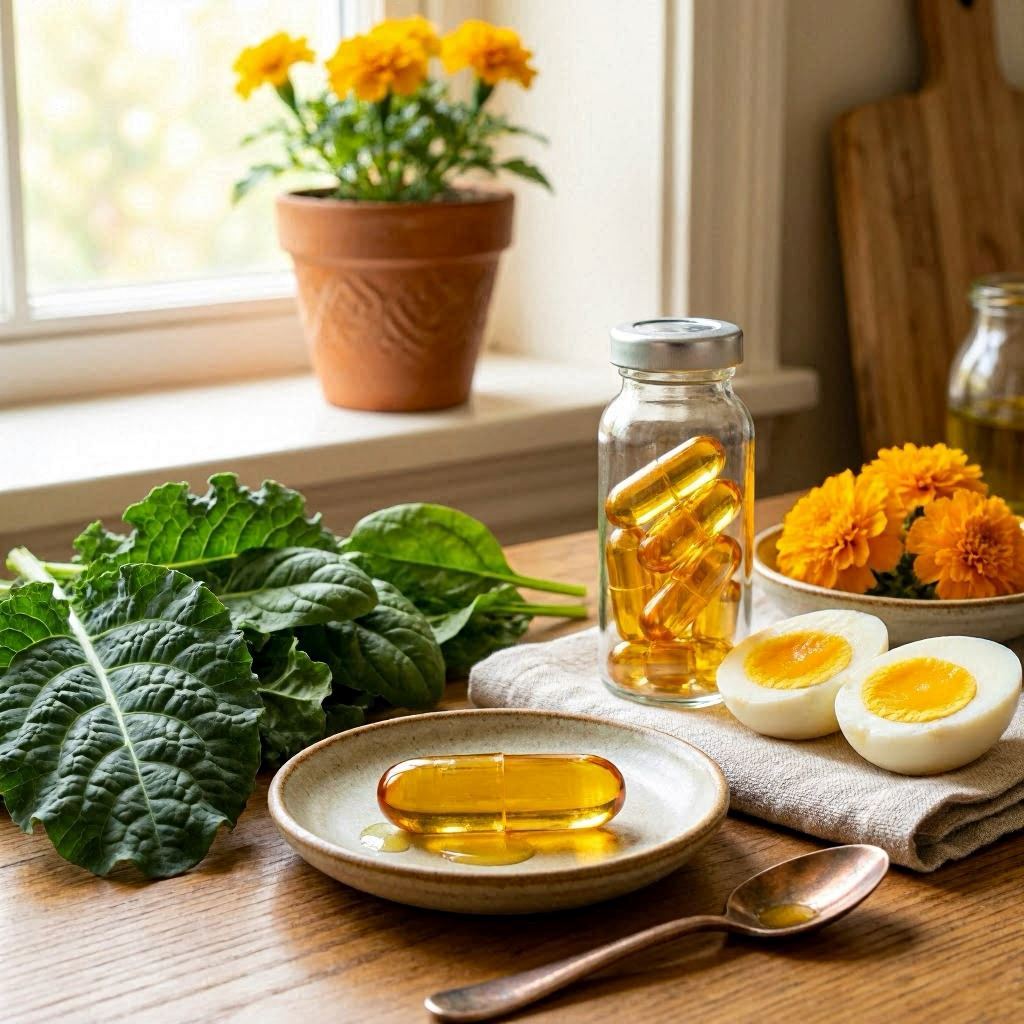
Lutein is a naturally occurring carotenoid pigment found in high concentrations in dark leafy greens (kale, spinach), egg yolks, and marigold flowers. It is classified as a xanthophyll carotenoid — a subgroup of carotenoids that contain oxygen atoms in their molecular structure, distinguishing them from pure hydrocarbon carotenoids like beta-carotene.
Commercially, lutein for supplement use is almost exclusively derived from marigold flowers (Tagetes erecta), which offer the highest natural concentration and the most scalable extraction pathway. The extract is standardized against total carotenoid content, with lutein typically comprising 80–90% of the carotenoid fraction and zeaxanthin — its closely related isomer — making up most of the remainder.
Why Lutein Is in High Demand Right Now
Three converging trends are driving lutein’s commercial relevance in 2024–2025:
The blue-light protection narrative With screen time at historic highs across all age groups, consumer awareness of high-energy visible (HEV) light damage to the retina has reached mainstream audiences. Lutein and zeaxanthin are the only carotenoids that accumulate in the macula — the central, highest-resolution part of the retina — where they act as a biological filter for blue light. This is a story that resonates with consumers aged 25–55 who spend 8+ hours per day in front of screens.
Cognitive health crossover Research published in journals including Nutrients and the British Journal of Nutrition has identified lutein as the dominant carotenoid in brain tissue. Studies in older adults have linked higher macular pigment optical density (a proxy for lutein status) to better performance on measures of processing speed, executive function, and memory. This creates a compelling dual-claim opportunity: eye health and brain health from a single ingredient.
Sports and performance nutrition Emerging research suggests lutein may reduce exercise-induced oxidative stress and support muscle recovery, opening doors into the sports nutrition segment — a market that has historically underutilized carotenoids.
Understanding Lutein Extract Grades and Specifications
Common commercial concentrations
Lutein is available at several standardized concentrations:
- 5% lutein (in oil suspension): most common for gummy and softgel applications
- 20% lutein (powder or beadlet): widely used in capsule and tablet formats
- 40–80% lutein (crystalline or free-form): used in premium eye health formulas and clinical research dosages
- FloraGLO and Lutemax 2020: trademarked branded ingredient forms that some formulators specify for the associated clinical substantiation
For most private label entry-level eye health products, 20% marigold extract at 10–20mg lutein per serving is the standard effective range supported by clinical literature.
Free lutein vs. lutein esters
This distinction matters for your formulation and your claims:
Lutein esters are the naturally occurring form in marigold petals — lutein bound to fatty acids. They require saponification (hydrolysis) during processing to yield free lutein. Free lutein is more bioavailable and is the form measured in most clinical studies.
When a supplier offers “20% lutein extract,” confirm whether this refers to free lutein content or lutein ester content. The difference in actual bioavailable lutein can be 30–40%, which directly affects whether your product delivers at label claim.
Clinical Evidence at a Glance
The clinical foundation for lutein is strong and well-documented:
The Age-Related Eye Disease Study 2 (AREDS2), conducted by the National Eye Institute, found that supplementation with lutein and zeaxanthin reduced the risk of progression to advanced age-related macular degeneration (AMD) in high-risk individuals. This study established lutein as a foundational eye health ingredient with substantial institutional backing.
Multiple independent randomized controlled trials have demonstrated that daily supplementation with 10–20mg of free lutein increases macular pigment optical density (MPOD) within 12–24 weeks, with effects maintained over long-term use.
For cognitive claims, studies using 10mg/day over 12 months in older women showed measurable improvements in verbal fluency and memory scores versus placebo.
Sourcing Lutein: What to Ask and What to Watch For
Documentation to request
Every reputable lutein supplier should provide without hesitation:
- HPLC test report confirming free lutein and zeaxanthin content
- Heavy metals panel (lead, arsenic, cadmium) — marigold is a soil accumulator
- Pesticide residue screening, particularly if sourcing from India (the dominant production region)
- Solvent residue declaration (hexane is commonly used in extraction)
- Microbial testing including yeast, mold, and pathogen panels
- Color specification (OD value or visual color card) for batch consistency
- Particle size data if purchasing powder for direct compression
Red flags in supplier documentation
Watch out for the following when reviewing supplier COAs:
- Lutein content reported as “total carotenoids” rather than specifically measured free lutein — these numbers are not interchangeable
- Missing zeaxanthin declaration — legitimate marigold extracts always contain some zeaxanthin
- Heavy metal results reported only as “pass/fail” without numerical values
- Pesticide testing limited to a small panel (fewer than 200 compounds is considered inadequate for EU-bound products)
Sourcing geography
India produces approximately 70% of the world’s commercial marigold-derived lutein. China is the second major producer. Both regions can supply high-quality material, but quality controls vary dramatically between manufacturers. Request facility audit reports or third-party GMP certification documentation.
Formulation and Product Ideas for Small Brands
Lutein’s market positioning is flexible. Consider these product directions:
Core eye health SKU Lutein 20mg + Zeaxanthin 4mg + Bilberry extract + Zinc. This mirrors the AREDS2 nutrient profile and can carry strong structure/function claims in US supplement regulations.
Digital wellness / screen protection Lutein 10mg + Vitamin C + Vitamin E + B2. Positioned for the 25–40 age bracket. Label creative around blue-light, screen fatigue, and modern work-life — a high-conversion narrative in e-commerce.
Cognitive + vision dual-benefit formula Lutein 20mg + Sialic acid + Phosphatidylserine + Omega-3 DHA. Targets the brain health market while retaining the eye health story. Premium positioning, higher retail price point.
Children’s vision support Lutein 5–6mg (age-appropriate dosing) in a chewable or gummy format. Growing category with relatively low competition compared to adult eye health.
Final Thoughts
Lutein is one of the most clinically substantiated, consumer-recognized, and commercially versatile ingredients available to supplement formulators today. For brands entering the eye health or cognitive wellness space, it offers a proven foundation with significant room for product innovation.
The key to success is sourcing verified, high-purity free lutein from a manufacturer with transparent documentation practices. In a category where label fraud is a known problem, quality assurance is your strongest competitive advantage.