










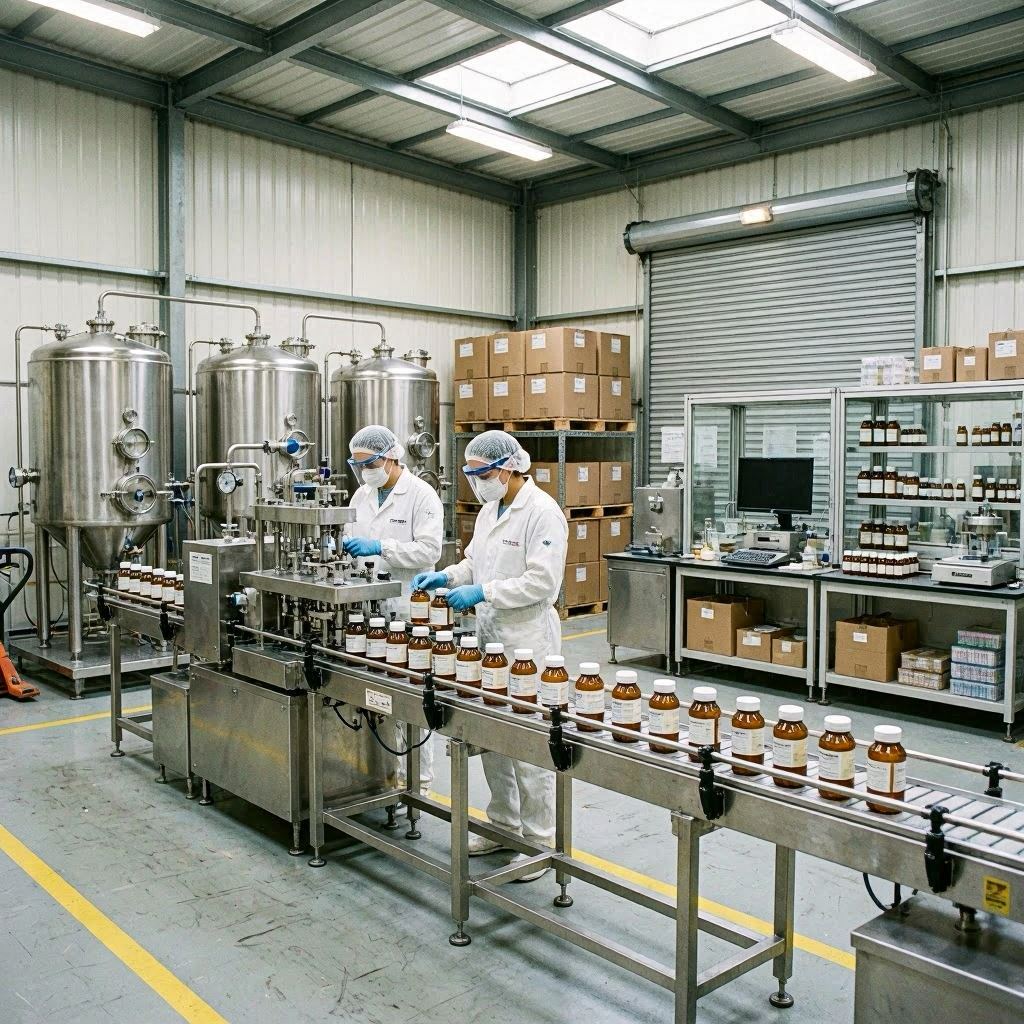
Introduction: The OEM Factory Decision That Makes or Breaks Your Brand
In the supplement industry, your OEM factory is not just a vendor—it is your most critical operational partner. The factory determines your product quality, compliance status, speed to market, and ultimately your brand reputation. Choosing poorly can result in FDA warning letters, Amazon listing suspensions, customer refund tsunamis, and catastrophic brand failure.
Conversely, aligning with the right supplement OEM factory—especially one specializing in high-value bioactive and peptide ingredients—gives you a sustainable competitive moat that competitors cannot easily replicate.
This guide is written for Amazon FBA sellers, Shopify DTC founders, cross-border sourcing teams, and procurement managers evaluating contract manufacturing options in the US, China, and EU markets.
Section 1: What Is a Supplement OEM Factory?
An OEM (Original Equipment Manufacturer) factory in the supplement space is a GMP-certified facility that manufactures finished dietary supplement products according to a client’s specifications. The client typically owns the formula, brand, and label; the factory handles raw material sourcing, blending, encapsulation, packaging, and quality control.
Key distinctions within the manufacturing model:
- Pure OEM: Client supplies proprietary formula. Factory manufactures with no IP sharing.
- ODM with customization: Factory provides base formulas; client customizes actives, flavors, dosages, and branding.
- White label / Private label: Fully finished products are simply re-labeled. Fastest time to market, least differentiation.
- Full-service R&D OEM: Factory co-develops formulas with PhD nutritionists. Best for brands targeting premium or clinical-grade positioning.
Section 2: Essential Certifications for Supplement OEM Factories
Before engaging any supplement OEM factory, verify their certification stack. Requirements vary by target market:
- GMP (Good Manufacturing Practice): The baseline. In the US, FDA 21 CFR Part 111. In China, NMPA GMP. In EU, EC 178/2002.
- ISO 22000 or FSSC 22000: Food safety management system. International standard recognized across EU, UK, AUS markets.
- NSF Certified for Sport: Required if targeting sports nutrition channels or professional athletes.
- Halal / Kosher Certification: Essential for Middle East, Southeast Asia, and Jewish consumer markets.
- Organic Certification (USDA / EU Organic): Necessary if marketing as certified organic.
- Non-GMO Project Verified: Increasingly required by US health food channel buyers.
A factory serving global supplement brands—particularly those targeting the US, UK, Australia, Germany, and Canada—should hold a minimum of GMP + ISO 22000 + one faith-based certification.
Section 3: Evaluating Active Peptide Manufacturing Capability
If your brand strategy includes premium bioactive ingredients—collagen peptides, NMN, GHK-Cu, marine peptides, or emerging GLP-1 support compounds—your OEM factory must have demonstrated technical competence in this category.
Key questions to ask prospective factories:
- Do you have in-house peptide stability testing (HPLC, LC-MS)?
- Can you source certified, traceable raw peptides from regulated suppliers?
- Have you produced products with NMN, marine collagen, or copper peptides previously? Can you share COAs?
- Do you have PhD-level formulators with peptide biochemistry expertise on staff?
- Can you achieve hydrolyzed peptide molecular weight below 1,000 Da for enhanced bioavailability?
Factories with genuine peptide manufacturing capability will answer these questions fluently and often proactively share technical data sheets and formulation rationale.
Section 4: MOQ, Lead Times, and Pricing Structure
For small-to-mid-size brands and Amazon FBA operators, Minimum Order Quantity (MOQ) is often the primary concern. Here’s what to expect from reputable supplement OEM factories:
- Capsules/Tablets: MOQ 5,000–10,000 units for standard formulas; some factories offer 3,000-unit test runs
- Gummy Supplements: MOQ typically 3,000–5,000 units due to gummy-specific tooling costs
- Powders/Sachets: MOQ 500–1,000 kg or 5,000 sachets
- Liquid Shots/Tonics: MOQ 5,000–10,000 units
Lead times vary significantly: ODM/white-label products can ship in 15–30 days. Custom OEM with new formula development requires 60–120 days including stability testing. Always build a buffer of 2–4 weeks for logistics, particularly for cross-border shipments from China to the US or EU.
Section 5: Quality Control and Third-Party Testing
A credible supplement OEM factory implements a multi-stage quality control process:
- Incoming Raw Material Testing: Heavy metals, pesticides, microbiological contamination, identity verification
- In-Process Quality Checks: Blend uniformity, moisture content, fill weight verification
- Finished Product COA: Potency, purity, microbial limits, shelf life projection
- Retention Samples: Maintain 12–36 months of retained samples per batch
Brands targeting Amazon, Shopify, or retail chains should insist on third-party COAs from accredited labs (ISO 17025 certified). This protects against marketplace delistings and consumer complaints.
Section 6: Red Flags When Evaluating Supplement OEM Factories
After reviewing hundreds of manufacturer profiles, here are the most common warning signs:
- Cannot provide original third-party COAs (only factory-generated documents)
- Unwilling to sign a Non-Disclosure Agreement before formula discussions
- No verifiable GMP certification (check FDA’s registered facility database or equivalent)
- Suspiciously low pricing (often indicates underdosed actives or substituted ingredients)
- No R&D capability—only toll manufacturing
- Poor English communication and delayed response times during evaluation phase
- No experience with your specific target market’s regulatory requirements
Section 7: Building a Long-Term OEM Partnership for Brand Growth
The best supplement brands treat their OEM factory as a strategic partner, not a commodity vendor. High-value partnership behaviors include:
- Annual volume commitments in exchange for pricing concessions
- Joint new product development roadmap (factory R&D + brand market insights)
- Regulatory co-development—factory assists with DSHEA substantiation, EU notifications
- Exclusive ingredient supply agreements for proprietary actives
Factories with an 80%+ client repurchase rate are those that invest in client success beyond just manufacturing. Look for this metric—or equivalent evidence of client retention—in your vendor evaluation.
FAQ: Supplement OEM Factory
Q: What is the difference between OEM and white label in supplement manufacturing?
A: OEM means you own the formula and specifications; the factory manufactures to your exact requirements. White label means the factory has a pre-made product that you simply brand and resell. OEM offers more differentiation and IP protection; white label offers faster speed to market. ODM falls between: factory formulas that you can customize with dosage adjustments, flavors, and additional actives.
Q: How do I verify that a supplement OEM factory is truly GMP certified?
A: For US-market products, verify the factory’s FDA facility registration at fda.gov/food/registration-food-facilities. For China-based factories, check NMPA (National Medical Products Administration) GMP records. Always request the factory’s most recent audit report from an accredited third-party auditor (SGS, Bureau Veritas, NSF International). Cross-reference the certificate number with the issuing body.
Q: What active peptide ingredients can a supplement OEM factory produce?
A: Elite supplement OEM factories with peptide specialization can produce collagen peptides (bovine, marine, plant-based), NMN, NR (nicotinamide riboside), GHK-Cu, BPC-157 (where legally permitted), beta-glucan, hyaluronic acid, and custom hydrolyzed peptide blends. Factories with HPLC/LC-MS testing capability can verify peptide molecular weight and bioavailability profiles.
Q: What MOQ should I expect from a supplement OEM factory for a first order?
A: Most credible GMP-certified OEM factories have MOQs between 3,000 and 10,000 units depending on format. Capsules and powders generally have lower MOQs (3,000–5,000); gummies require slightly higher runs due to equipment setup costs. Factories offering MOQs below 1,000 units often lack proper GMP infrastructure—proceed with caution.
References
[1] Mordor Intelligence. (2024). Nutraceutical Contract Manufacturing Market—Growth, Trends, and Forecasts 2024–2029.
[2] FDA. (2023). Current Good Manufacturing Practice (CGMP) Regulations: 21 CFR Part 111. fda.gov
[3] ISO. (2018). ISO 22000:2018 Food Safety Management Systems. iso.org
[4] NSF International. (2024). NSF Certified for Sport Program Requirements. nsf.org
[5] Korhonen, H., & Pihlanto, A. (2006). Bioactive peptides: Production and functionality. International Dairy Journal, 16(9), 945–960.
[6] Chakrabarti, S. et al. (2018). Food-derived bioactive peptides in human health: challenges and opportunities. Nutrients, 10(11), 1738.