










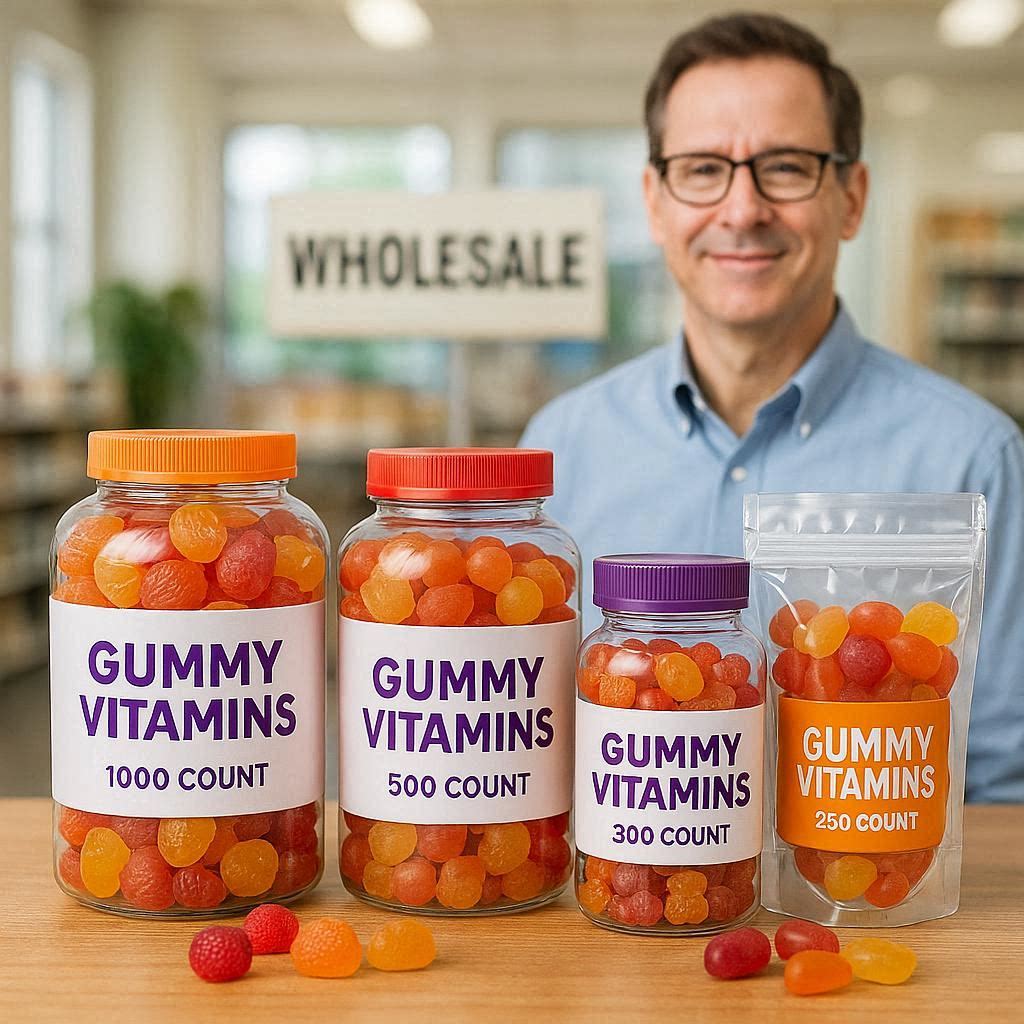
Introduction: Why Wholesale Gummy Vitamins Are One of the Fastest-Growing B2B Supplement Categories
The global gummy supplement market was valued at approximately USD 7.8 billion in 2023 and is forecast to grow at a CAGR exceeding 12% through 2030, driven by consumer preference for palatable, easy-to-swallow delivery formats over traditional tablets and capsules. For wholesale buyers — including Amazon FBA aggregators, Shopify DTC brand owners, TikTok Shop operators, brick-and-mortar health retailers, and gym chains — gummy vitamins represent one of the highest-margin, highest-repeat-purchase SKU categories available.
However, not all gummy vitamin wholesale suppliers are created equal. The supplement industry’s relatively low regulatory barrier at the retail level masks significant variation in manufacturing quality, ingredient potency, certification status, and supply chain reliability between suppliers. This guide provides a rigorous, science-informed framework for evaluating and selecting a gummy vitamins wholesale supplier capable of supporting your brand’s compliance requirements and growth trajectory.
The Science Behind Gummy Vitamin Formulation: What Separates a Quality Supplier from a Commodity One
Gummy vitamins are not simply confectionery with vitamins mixed in. A scientifically rigorous gummy formulation must navigate a series of complex ingredient-matrix interactions that determine whether the finished product delivers the labeled potency, maintains stability across its shelf life, and passes third-party testing upon arrival at a US, UK, or Australian fulfillment center.
1.1 Gelatin vs Pectin Matrix: The Foundation Decision
The gummy base — gelatin or pectin — fundamentally shapes formulation possibilities. Porcine or bovine gelatin produces a firmer, more heat-stable gummy with superior texture consistency at scale. However, it excludes HALAL, Kosher, and vegan market segments. Pectin-based (typically apple or citrus pectin) gummies are plant-derived, appealing to vegan and HALAL buyers, but require higher pectin concentrations, more precise pH management (optimal range: 3.0–3.8), and careful temperature control during depositing to avoid premature gelling.
1.2 Vitamin Stability in Gummy Matrix: Critical Degradation Pathways
| Vitamin / Active | Primary Degradation Risk in Gummy | Mitigation Strategy | Overage Typically Added |
| Vitamin A (Retinyl palmitate) | Oxidation; accelerated by light & heat | Antioxidant co-formulation (vitamin E, rosemary extract); opaque packaging | 10–20% |
| Vitamin C (Ascorbic acid) | Oxidation & pH-dependent degradation; reacts with gelatin | Buffered form (sodium ascorbate); encapsulation; nitrogen flushing | 20–30% |
| Vitamin D3 (Cholecalciferol) | Photodegradation; oil-water interface instability | Emulsified D3 in MCT oil; opaque bottle; desiccant pack | 10–15% |
| Vitamin B12 (Cyanocobalamin / Methylcobalamin) | Photolysis; reacts with reducing sugars (Maillard) | Low sugar formula; amber packaging; methylcobalamin preferred for stability | 15–25% |
| Folic acid / Methylfolate | Photodegradation; pH sensitivity | Encapsulation; pH-buffered system; dark packaging | 10–20% |
| Zinc (Zinc citrate / gluconate) | Precipitation in high-pH gummy | Zinc citrate preferred; pH-buffered depositing | 5–10% |
1.3 Sugar-Free and Functional Gummy Considerations
Sugar-free gummy vitamins — increasingly demanded across US keto, diabetic-friendly, and children’s segments — present additional formulation challenges. Polyol-based sweeteners (maltitol, sorbitol, xylitol, erythritol) require reformulated gelling systems because they interact differently with gelatin and pectin compared to sucrose. Erythritol-based sugar-free gummies in particular are prone to crystallization (“blooming”) if temperature cycling occurs during transit — a QC issue that a competent wholesale supplier must have protocols to address.
Wholesale Supplier Qualification Criteria: The Eight-Point Checklist
| Criteria | Minimum Standard | Premium Standard | How to Verify |
| GMP Certification | FDA 21 CFR Part 111 (US sales) | ISO 22000 + FSSC 22000 + BRC | Request current certificate; verify via issuing body |
| Third-Party COA | Per-batch COA from accredited lab | NSF, USP, or Informed Sport verification | Request COA for last 3 production batches |
| Potency Accuracy | ±10% of label claim (DSHEA minimum) | ±5% or better | Order sample; send to independent lab |
| Heavy Metal Testing | Pb, Cd, As, Hg per California Prop 65 limits | Comprehensive ICP-MS panel including all 8 metals | COA must include test values, not just ‘pass’ |
| Microbial Testing | Total plate count, yeast/mold, coliforms | Staph aureus, Salmonella, E. coli O157 panel | Included in COA; lab accreditation required |
| Shelf Life & Stability | 12-month stability data at minimum | 24–36 month with 40°C/75%RH accelerated data | Request stability protocol document |
| Minimum Order Quantity | ≤10,000 units for new SKU testing | ≤3,000 units at full GMP compliance | Confirmed in writing pre-agreement |
| Lead Time Reliability | Stated lead time with documented on-time rate | 45–90 day lead with ≥95% on-time delivery rate | Request references; ask about Q4 capacity |
Supply Chain Risk Management for Gummy Vitamin Wholesale Buyers
5.1 Ingredient Sourcing Transparency
Ask your wholesale supplier for ingredient COOs (Countries of Origin) and supplier qualification records for their raw material vendors. Vitamin D3 lanolin (from sheep’s wool) sourcing varies significantly in purity and sustainability credentials. Pectin sourcing (apple vs citrus) affects flavor compatibility. Zinc and magnesium mineral forms (citrate, glycinate, oxide) must be specified — zinc oxide is cheapest but has significantly lower bioavailability than zinc citrate or gluconate.
5.2 Capacity Planning and Lead Time Buffers
GMP-compliant gummy manufacturing requires scheduled cleaning validation between product changeovers, equipment qualification, and environmental monitoring — all of which reduce effective daily output versus non-GMP commodity producers. Plan for 45–90 day lead times and build a 60–90 day inventory buffer, particularly for Q4 (October–December), when contract manufacturers are typically at 80–95% capacity utilization.
5.3 Quality Holds and Rework Policies
Before placing your first wholesale order, obtain a written copy of the supplier’s quality hold and rework policy. Specifically: what happens if a batch fails potency testing? Who bears the cost of rework or replacement production? What is the timeline? A supplier with no clear written policy on this is a significant operational risk.
Why NuCoreBio Is the Preferred Gummy Vitamins Wholesale Supplier for Cross-Border Sellers
NuCoreBio is a GMP + ISO 22000 + FSSC 22000 + HALAL + BRC certified gummy vitamin OEM/ODM manufacturer and wholesale supplier based in China, purpose-built to serve Amazon FBA, Shopify, and TikTok Shop brands across the US, UK, Australia, Canada, and Germany.
- MOQ from 5000 units — the lowest GMP-compliant MOQ available at this certification tier
- PhD-led in-house R&D team — formulation, stability testing, and overage calculation included
- Ingredient COO documentation and full COA per batch as standard
- Regulatory documentation package for US FDA, UK FSA, TGA, Health Canada, and EFSA
- 45–90 day lead time with documented on-time delivery rate
- Free pre-production samples — quote within 48 hours
FAQ: Gummy Vitamins Wholesale Supplier
What is the typical MOQ for wholesale gummy vitamins?
MOQ varies widely by supplier type. Commodity distributors (selling pre-made, unbranded gummies) may offer 500–2,000 units but provide no GMP certification or COA. GMP-certified OEM/ODM manufacturers typically start at 3,000–10,000 units. For full-service custom formulation with certifications, NuCoreBio offers MOQs from 3,000 units.
How do I verify a wholesale gummy vitamin supplier’s GMP status?
Request the GMP certificate with the issuing body’s name and certificate number. Verify directly with the issuing body (e.g., NSF International, SGS, Bureau Veritas, or the relevant national regulatory authority). Check the certificate expiry date — GMP certification requires periodic re-auditing, typically every 2–3 years. An expired certificate is equivalent to no certificate for regulatory purposes.
Can I get HALAL-certified gummy vitamins from a wholesale supplier?
Yes, but HALAL certification requires both a pectin-based (pork-free) or bovine HALAL gelatin base AND alcohol-free processing across all equipment in the production facility. Request the HALAL certificate from the factory and verify the issuing Islamic certification body’s accreditation. For markets like the UAE, Saudi Arabia, Malaysia, and Indonesia, HALAL certification is essential for both retail and online platform listing compliance.
What third-party certifications add the most value for Amazon gummy vitamin listings?
For Amazon.com, NSF Certified for Sport or USP Verified seals command the highest consumer trust and support premium pricing. Informed Sport certification is valued in the sports nutrition subsegment. For general wellness gummies, a clean COA with named accredited lab (Eurofins, NSF, Intertek) shown in listing images has been shown to improve conversion rates measurably versus listings without any third-party verification signal.
Request Wholesale Pricing and Free Samples from NuCoreBio
Whether you’re sourcing a single hero SKU or building a full gummy vitamin line for wholesale distribution, NuCoreBio’s GMP-certified production infrastructure and PhD formulation team are ready to support your next product launch.
MOQ from 500 units. Free pre-production samples. 48-hour quote. Visit nucorebio.com or WhatsApp us to get started.