










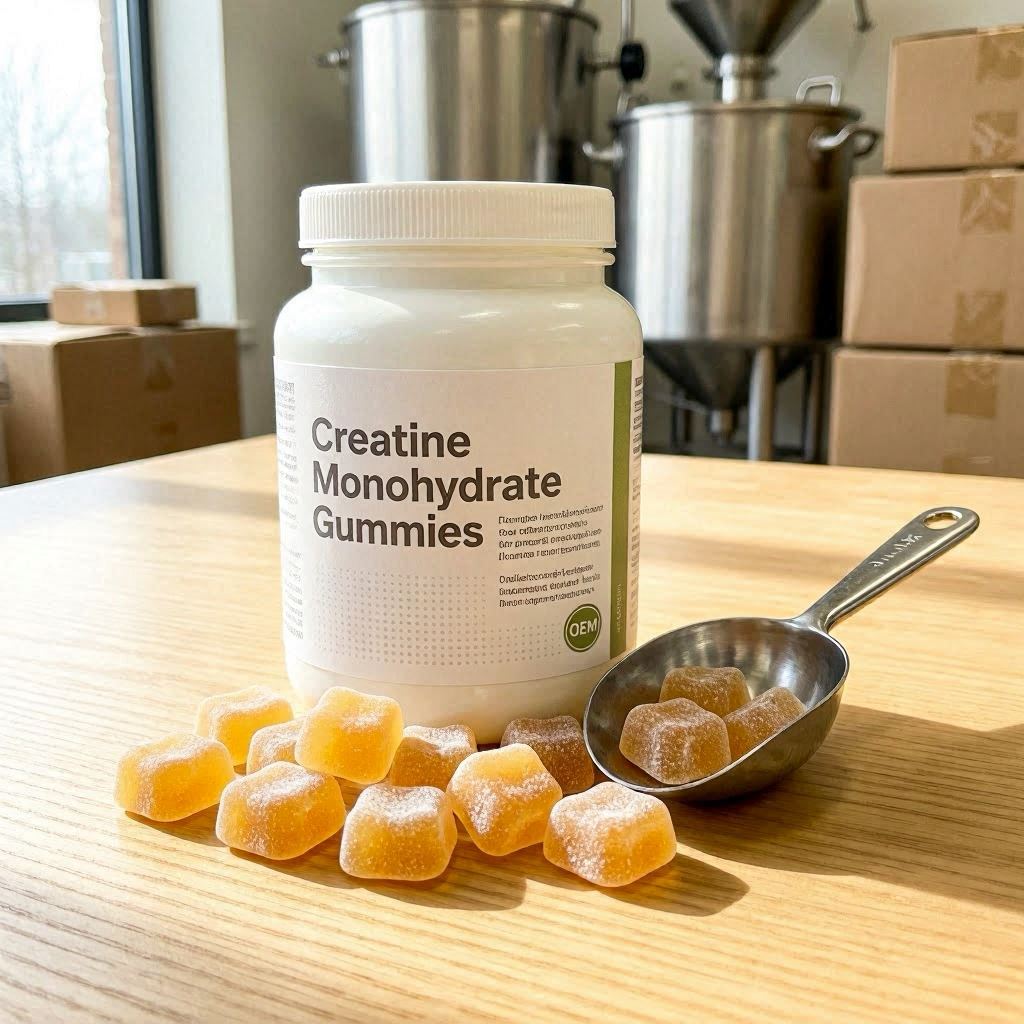
Market Explosion: Why 2024–2025 Is the Inflection Point
Creatine monohydrate holds the distinction of being the most rigorously studied performance nutrition ingredient, supported by over 500 peer-reviewed studies and endorsed by the International Society of Sports Nutrition (ISSN) as among the most effective ergogenic aids available. Despite this scientific pedigree, traditional creatine powder has faced persistent consumer experience barriers: gritty texture, mildly bitter taste, and inconvenient daily dosing. Creatine gummies solve all three. However, a July 2025 independent testing report by James Smith and Eurofins revealed that 5 of 9 tested creatine gummy brands contained near-zero creatine content. This quality crisis underscores that verified dosing and manufacturing rigor are the definitive competitive advantages in this category.
The Science of Creatine Monohydrate
Creatine monohydrate (C4H9N3O2) is a naturally occurring nitrogenous organic acid stored primarily in skeletal muscle (approximately 95%), where it functions as a rapid ATP resynthesis substrate via the phosphocreatine (PCr) system. Supplementation increases intramuscular PCr stores by 15–40%, directly extending high-intensity output capacity and accelerating recovery. EFSA has formally recognized creatine’s contribution to normal energy metabolism. Emerging research on cognitive applications — including improved performance under sleep deprivation — is expanding the positioning of creatine supplements beyond traditional athletic audiences to biohackers and longevity-focused consumers, a segment that grew 6.4% in market share by 2025.
Formulation Challenges & Quality Barriers in Gummy Format
Creatine gummy formulation presents technically significant challenges compared to standard vitamin gummies, which explains why independent testing has revealed widespread under-dosing in the category. Key challenges include: crystallization during setting (leading to non-uniform active distribution or gritty texture), pH-mediated hydrolysis to creatinine (which accelerates below pH 4.5 — a concern given the citric acid commonly used in gummy flavoring), and high-load constraints (3–5g/day effective dose versus approximately 1.5–2g per gummy capacity). Responsible manufacturers address these through controlled pH formulation, specialized creatine mesh size selection (80 vs. 200 mesh), and mandatory blend uniformity testing per batch.
OEM Verification: How to Assess Manufacturer Technical Capability
Given the documented quality failures revealed in 2025 testing, a rigorous OEM audit protocol is non-negotiable for Creatine Gummies brands. Mandatory verification steps include: HPLC-based creatine quantification in every batch COA (not just visual inspection); blend uniformity reports demonstrating RSD ≤ 5% per-gummy; confirmed formulation pH ≥ 4.5 to minimize hydrolysis; accelerated stability testing (40°C/75% RH, 6 months) showing ≥90% potency retention; and NSF Certified for Sport or Informed Sport certification for brands targeting athletic markets where anti-doping compliance is a commercial requirement.
Product Line Architecture & Market Positioning
Three clear consumer positioning tracks exist for Creatine Monohydrate Gummies brands: (1) Performance — targeting strength training and high-intensity sport athletes with a 3–5g/day effective dose, zero-prep convenience message; (2) Cognitive + Wellness — targeting biohackers and longevity-focused adults using EFSA-recognized energy metabolism claims; (3) Women’s Fitness — an underserved segment where research shows comparable or superior creatine response in women (particularly during the menstrual cycle), with gummy format and female-oriented packaging as differentiation vehicles.
Pricing Strategy & Margin Modeling
Creatine gummies command a significant retail premium over powders: a 60-count (30-day) gummy product retails at $25–45 versus $20–25 for an equivalent powder dose. With OEM manufacturing costs for 500-unit MOQs typically in the $4–8/bottle range (depending on dose, format, and certification requirements), gross margin profiles of 65–75% are achievable at competitive retail price points, making Creatine Gummies one of the highest-margin entry points in the sports nutrition OEM category.
FAQ
Q1: Can creatine gummies achieve the same bioavailability as traditional powder? Yes, provided formulation pH is maintained above 4.5 and the per-serving dose is equivalent. Creatine monohydrate’s bioavailability is determined by dissolution and absorption kinetics in the GI tract, not by delivery format. Clinically effective daily doses (3–5g maintenance, 20g/day loading for 5–7 days) achieve equivalent intramuscular PCr elevation regardless of format — the critical variable is verified per-gummy active content via HPLC testing.
Q2: Given the 2025 testing scandal revealing near-zero creatine in five brands, how should a new brand protect against this risk? Implement a three-layer verification protocol: pre-production raw material HPLC verification with third-party confirmation; mandatory BUR testing before finished goods release; and post-launch independent market surveillance testing (Eurofins, NSF International) with transparent public disclosure of results to build consumer trust. Selecting an NSF Certified for Sport manufacturing partner is the most effective single risk mitigation measure.
Q3: Are creatine gummies suitable for vegan consumers, and do OEM manufacturers offer plant-based formulations? Creatine monohydrate is synthetically produced and contains no animal-derived ingredients, making it inherently suitable for vegan diets. The key variable is the gummy base: pectin or carrageenan substitutions for gelatin yield a fully vegan product. Most established OEM manufacturers offer both gelatin and pectin-base variants, and can support Vegan Society or halal certification applications.
Q4: What are the regulatory classifications for Creatine Monohydrate Gummies across major markets? In the US, creatine monohydrate is a lawful dietary ingredient under DSHEA, permitting structure/function claims such as ‘supports muscle energy metabolism.’ In the EU, EFSA has formally approved the claim ‘creatine increases physical performance in successive bursts of short-term, high intensity exercise’ under Regulation (EC) No 1924/2006, applicable to products providing ≥3g/day. In the UK post-Brexit, creatine is recognized as a food supplement ingredient under the FSA framework with an approval pathway analogous to the EU model.
References
1. Kreider, R.B. et al. (2017). International Society of Sports Nutrition position stand: safety and efficacy of creatine supplementation in exercise, sport, and medicine. Journal of the International Society of Sports Nutrition, 14, 18. https://doi.org/10.1186/s12970-017-0173-z
2. EFSA Panel on Dietetic Products (2011). Scientific Opinion on the substantiation of health claims related to creatine. EFSA Journal, 9(7), 2303.
3. Smith, J. & Eurofins Scientific (2025, July). Independent Testing of Commercial Creatine Gummy Products. Nutraceuticals World, February 2026.
4. Future Market Insights (2025). Creatine Supplement Market: Demand & Outlook 2025 to 2035.
5. Lanhers, C. et al. (2017). Creatine supplementation and upper limb strength performance: a systematic review and meta-analysis. Sports Medicine, 47(1), 163–173.
6. US FDA. 21 CFR Part 101 — Food Labeling: Nutrient Content Claims and Health Claims for Dietary Supplements.