Overview
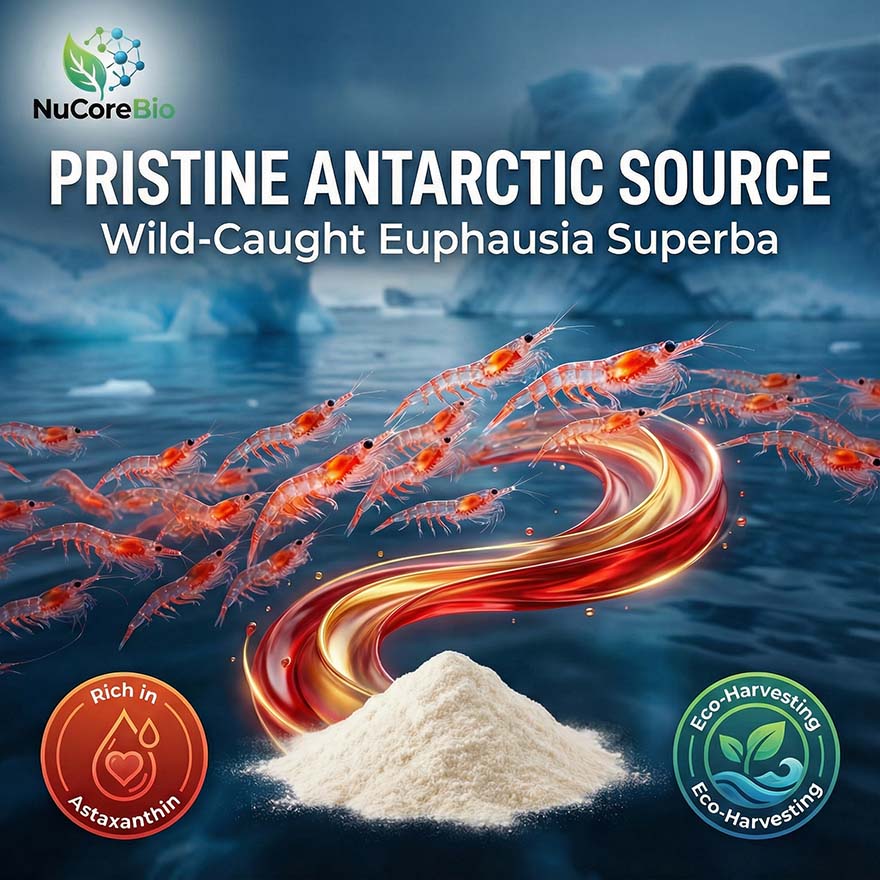
Antarctic Krill Protein Peptide (AKPP) is a class of bioactive small-molecule peptides derived from Antarctic krill (Euphausia superba). Through advanced enzymatic hydrolysis, large krill proteins are broken down into smaller, highly absorbable peptides. Rich in 18 essential amino acids and exhibiting multiple physiological activities, AKPP has become a focal point in functional foods, nutraceuticals, and biomedical research.
Key Benefits Supported by Scientific Research
- Cognitive Enhancement & Neuroprotection
Recent studies (2024) show that Antarctic Krill Protein Peptide significantly improves memory impairment in animal models. It acts by modulating key signaling pathways in the hippocampus—including BCL-XL/Bax/Caspase-3/p53/CREB/BDNF—thereby protecting neurons and enhancing learning and memory function. - Antioxidant & Antihypertensive Effects
AKPP demonstrates strong free radical scavenging activity (DPPH·, ABTS⁺·). Its antihypertensive effect is primarily attributed to ACE (angiotensin-converting enzyme) inhibition, with some peptide fractions achieving an IC50 value as low as 0.22 mg/mL—comparable to certain pharmaceutical agents. - Immune Modulation
A 2026 study identified a specific immunomodulatory peptide (RDWPEGRG) from Antarctic krill hydrolysates. This peptide activates macrophages, enhancing proliferation, phagocytosis, and nitric oxide secretion, thereby demonstrating significant immune-enhancing potential at both cellular and animal levels. - Other Potential Benefits
Anti-fatigue & hypoxia tolerance: Extends swimming time and hypoxia survival in animal models.
Blood glucose regulation: Inhibits α-glucosidase and DPP-IV, suggesting potential for glycemic control support.
Production Process & Technical Advantages
Primary Method: Enzymatic Hydrolysis
This is the most widely used industrial approach. Specific proteases (e.g., trypsin, alkaline protease, marine bacterial proteases) hydrolyze krill protein under controlled conditions.
Advantages: Mild conditions, high specificity, reproducible quality.
Quality control: Advanced processes ensure over 99% of peptides have a molecular weight below 3000 Da, maximizing bioavailability.
Alternative Methods
Microbial fermentation: Produces complex bioactive mixtures but with greater batch variability.
Autolysis: Uses krill’s endogenous enzymes but is difficult to control consistently.
Structural & Nutritional Advantages
Complete amino acid profile: Contains all 18 amino acids, including 8 essential ones.
High absorption rate: Small-molecule peptides are absorbed directly without extensive digestion.
Amphiphilic nature: Derived from krill’s unique lipid-protein composition, enabling diverse formulation applications.
Future Outlook & Industry Challenges
Promising Applications: AKPP is well-positioned for use in functional foods targeting memory enhancement, blood pressure regulation, immune support, and fatigue recovery.
Challenges:
Structure-activity relationship: Requires deeper understanding of how specific peptide sequences drive specific functions.
Bioavailability: Needs more rigorous human data on digestion stability and absorption.
Industrial consistency: Ensuring batch-to-batch consistency in large-scale production remains critical.