










Introduction: Why CoQ10 + PQQ Is One of the Most Scientifically Compelling Gummy Supplement Combinations
Coenzyme Q10 (CoQ10) and Pyrroloquinoline Quinone (PQQ) represent two of the most well-researched mitochondria-targeting compounds in the dietary supplement industry. Their combination — increasingly marketed under “cellular energy,” “mitochondrial support,” and “cognitive longevity” positioning — has emerged as a high-demand SKU category across the US, UK, and Australian premium supplement markets.
For B2B supplement buyers and private label brand founders, CoQ10 PQQ gummies represent both a significant opportunity and a meaningful formulation challenge. Both actives are oil-soluble, expensive, and highly sensitive to temperature, oxidation, and pH — making gummy format manufacturing substantially more complex than standard water-soluble vitamin gummies. This guide explains the science, the formulation engineering required, and what to look for in a qualified CoQ10 PQQ gummies manufacturer.
The Science Behind CoQ10 and PQQ: Why This Combination Makes Biological Sense
1.1 CoQ10: The Mitochondrial Electron Carrier
Coenzyme Q10, also known as ubiquinone (oxidized form) or ubiquinol (reduced, active form), is an endogenously synthesized fat-soluble quinone that plays a central role in mitochondrial oxidative phosphorylation. Specifically, CoQ10 shuttles electrons between Complex I and Complex II to Complex III of the electron transport chain (ETC), enabling ATP synthesis. Beyond its role in energy metabolism, CoQ10 functions as a potent membrane-bound antioxidant, quenching lipid peroxyl radicals and protecting mitochondrial membrane integrity.
Endogenous CoQ10 synthesis declines progressively with age — estimated at approximately 0.5% per year after age 20 — and is further reduced by statin medications (which block the mevalonate pathway shared by both cholesterol and CoQ10 synthesis). Clinical research supports supplemental CoQ10 (100–300mg/day) for cardiovascular function, exercise performance, and statin-induced myopathy mitigation, with robust safety data across decades of study.
1.2 PQQ: The Mitochondrial Biogenesis Activator
Pyrroloquinoline Quinone (PQQ, also called methoxatin) is a redox cofactor first identified in bacteria and later found in human tissues at nanomolar concentrations. PQQ is notable for its exceptional redox cycling capacity — it can perform up to 20,000 catalytic cycles before degradation, compared to approximately 4 cycles for vitamin C. PQQ’s primary mechanism of interest in human supplementation is the activation of PGC-1α (peroxisome proliferator-activated receptor gamma coactivator 1-alpha), the master regulator of mitochondrial biogenesis — the process of creating new mitochondria.
A landmark 2010 human clinical trial published in the Journal of Nutritional Biochemistry demonstrated that 20mg/day PQQ supplementation for 8 weeks significantly improved urinary markers of mitochondrial biogenesis. Subsequent research has explored PQQ’s neuroprotective effects, particularly its role in modulating NGF (nerve growth factor) expression and protecting against oxidative neuronal damage.
1.3 The Synergistic Case for CoQ10 + PQQ Co-Formulation
The scientific rationale for combining CoQ10 and PQQ is compelling from a systems biology perspective: CoQ10 optimizes the function of existing mitochondria (ATP yield, membrane protection), while PQQ promotes the creation of new mitochondria via PGC-1α activation. Together, they address both mitochondrial efficiency and mitochondrial quantity — complementary rather than redundant mechanisms.
Animal studies have demonstrated additive cognitive benefits when CoQ10 and PQQ are co-administered, with particular effects on memory and spatial learning tasks mediated through preserved hippocampal mitochondrial function. This positions the CoQ10+PQQ gummy as a scientifically defensible “nootropic/longevity” product with differentiated positioning beyond generic energy gummies.
CoQ10 PQQ Gummy Formulation: Key Technical Challenges Every Manufacturer Must Solve
2.1 Lipophilicity and Bioavailability: The Core Problem
Both CoQ10 and PQQ are poorly water-soluble, which creates immediate challenges in gummy manufacturing — a predominantly aqueous process. Standard CoQ10 bioavailability from crystalline powder formulations is approximately 3–5% of oral dose. Overcoming this requires advanced solubilization or delivery technologies:
| Technology | Description | Bioavailability Impact | Manufacturing Complexity |
| Ubiquinol (reduced CoQ10) | Pre-reduced, more bioavailable form of CoQ10; unstable without antioxidant protection | +50–100% vs ubiquinone in some studies | High — requires oxygen-free processing |
| Lipid-based self-emulsifying (SEDDS) | CoQ10 dissolved in lipid carrier + emulsifier; forms nanoemulsion in GI tract | 2–3x improvement over crystalline CoQ10 | High — requires specialized equipment |
| Cyclodextrin inclusion complex | CoQ10 encapsulated in cyclodextrin ring structure; water-dispersible | ~30–60% improvement; heat-stable | Moderate — co-spray dry required |
| Nano-emulsion / Micellar CoQ10 | Submicron particle size (≤200nm); water-dispersible powder or liquid | Up to 3–5x vs standard crystalline | High — tight particle size QC required |
| Standard crystalline CoQ10 (ubiquinone) | Raw powder; lowest cost; lowest bioavailability | Baseline (lowest) | Low — direct blend possible |
PQQ Dosing and Form Selection in Gummies
PQQ is commercially available primarily as PQQ disodium salt (BioPQQ® is the most well-studied branded form, patented by Mitsubishi Gas Chemical). Effective doses in human clinical trials range from 10–20mg/day. At these doses, PQQ’s bitter, slightly acidic taste character is detectable and requires masking — typically through dark berry flavor systems (blackcurrant, elderberry, blueberry) that contain complementary bitter notes.
2.3 Oxidative Stability: The Manufacturing Environment Requirement
Ubiquinol (reduced CoQ10) is highly susceptible to oxidation back to ubiquinone when exposed to oxygen, light, or elevated temperature. Manufacturing a gummy containing ubiquinol requires nitrogen-blanketed mixing environments, oxygen-free depositing chambers, and oxygen-barrier packaging (typically aluminum foil-lined blister packs or opaque HDPE bottles with nitrogen flush and desiccant packs). A manufacturer without these capabilities should not be producing ubiquinol-containing products.
2.4 Dosage Per Gummy Piece: The Mass Loading Challenge
Typical gummy piece weight is 2–4g per piece. At standard active ingredient load percentages, fitting 100–200mg CoQ10 + 10–20mg PQQ per piece without compromising texture, taste, or gelling performance is technically demanding. Solutions include:
- Using 2-piece serving size (doubles active payload per serving without reformulation)
- Adopting high-load CoQ10 forms with superior dispersibility (nano-emulsion powders achieve higher load at equivalent weight)
- Adjusting piece size to 4–5g (larger gummy, lower piece-count bottle, same total dose)
How to Evaluate a CoQ10 PQQ Gummies Manufacturer: Technical Due Diligence
4.1 Raw Material Credential Questions
- Can you specify the CoQ10 form (ubiquinone vs ubiquinol) and provide the raw material supplier’s CoA and specification sheet?
- Is PQQ sourced as BioPQQ® (Mitsubishi) or a generic PQQ salt? What third-party verification does the raw material have?
- What is the CoQ10 purity specification (standard: ≥98% by HPLC)?
- Is the PQQ manufactured under HACCP-certified conditions with heavy metal testing?
4.2 Bioavailability and Delivery Technology Capability
- Can the factory produce lipid-based or nano-emulsion CoQ10 gummies, or only standard crystalline blend?
- What oxygen control systems exist in the manufacturing environment for ubiquinol products?
- Can the factory provide comparative dissolution data between their CoQ10 gummy and a standard powder capsule?
4.3 Stability Testing Protocol
Request a stability testing protocol for CoQ10 gummies specifically. Key parameters: CoQ10 assay at T=0, T=3, T=6, T=12 months; ubiquinol oxidation ratio if applicable; PQQ assay (HPLC); color, texture, and water activity measurements. Stability should be performed at 25°C/60%RH (standard) and 40°C/75%RH (accelerated), with samples stored in final commercial packaging.
NuCoreBio: Your Certified CoQ10 PQQ Gummies Manufacturing Partner
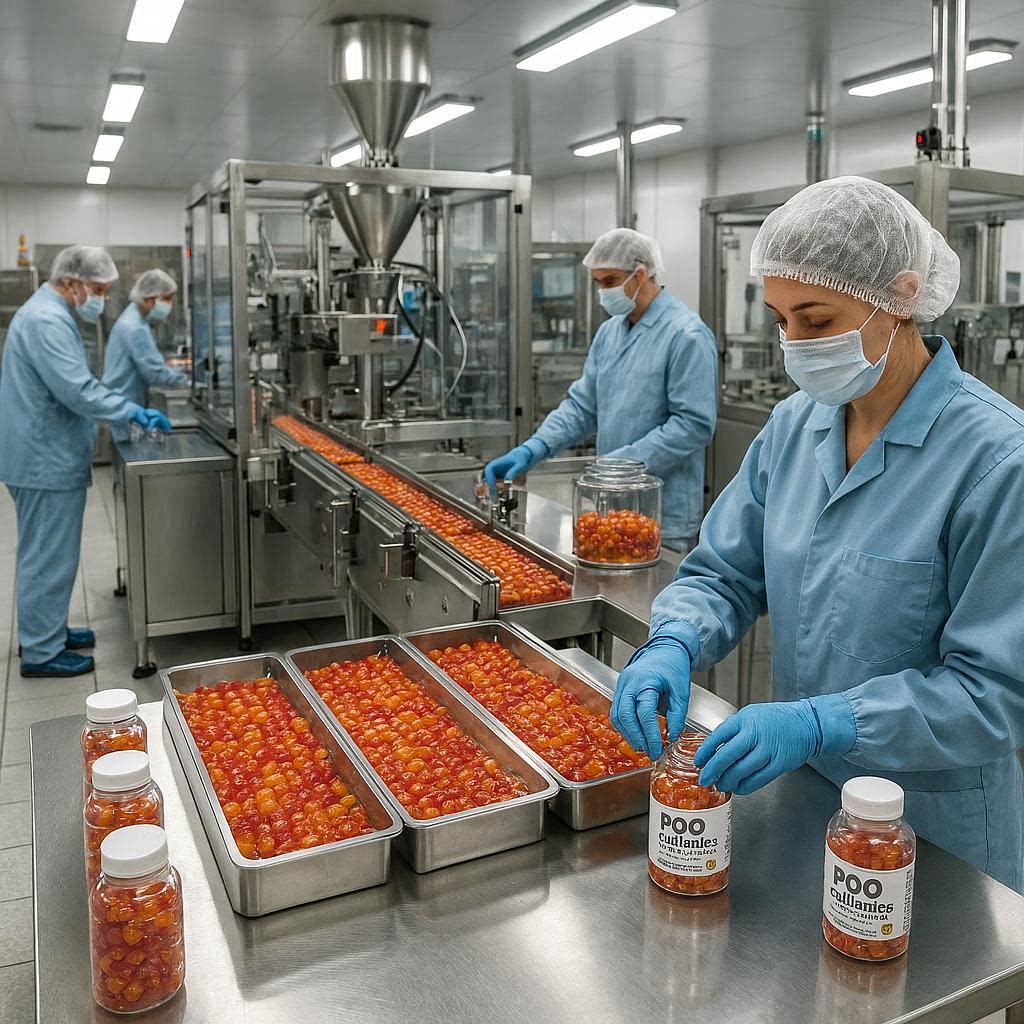
NuCoreBio provides end-to-end CoQ10 PQQ gummy manufacturing services — from raw material sourcing and bioavailability-optimized formulation through GMP production, stability testing, and full regulatory documentation for US, UK, Australian, Canadian, and German markets.
FAQ: CoQ10 PQQ Gummies Manufacturer
What is the recommended dosage of CoQ10 and PQQ per gummy serving?
Based on published human clinical research, effective doses are 100–300mg/day for CoQ10 (with 200mg being the most commonly studied) and 10–20mg/day for PQQ. A two-gummy serving size allows manufacturers to deliver 100mg CoQ10 + 10mg PQQ per piece (200mg + 20mg per serving) while maintaining manageable piece weight and manufacturing feasibility.
Is ubiquinol or ubiquinone better for gummy formulations?
Ubiquinol (reduced CoQ10) offers superior bioavailability — particularly relevant for older adults (50+) who convert ubiquinone to ubiquinol less efficiently. However, ubiquinol is significantly more expensive and requires oxygen-free manufacturing conditions. For general wellness gummies targeting adults under 50, ubiquinone at 200mg with a nano-emulsion or SEDDS delivery system can achieve comparable clinical relevance at lower cost. For premium longevity-positioned products, ubiquinol is the scientifically preferred choice.
What packaging is required for CoQ10 PQQ gummies to maintain stability?
Oxygen-barrier packaging is essential for any CoQ10 gummy, and mandatory for ubiquinol-containing formulations. Recommended: HDPE opaque bottles with nitrogen headspace flush + molecular sieve desiccant + induction seal, or aluminum foil-lined blister packs. Avoid transparent PET bottles — even if appearance is preferred by some brands, UV and oxygen ingress will accelerate CoQ10 degradation and reduce shelf life.
Start Your CoQ10 PQQ Gummy Project with NuCoreBio
Partner with a GMP-certified manufacturer that understands the unique formulation science behind CoQ10 and PQQ — and can deliver a bioavailability-optimized, stability-tested gummy with full regulatory documentation for your target markets.