










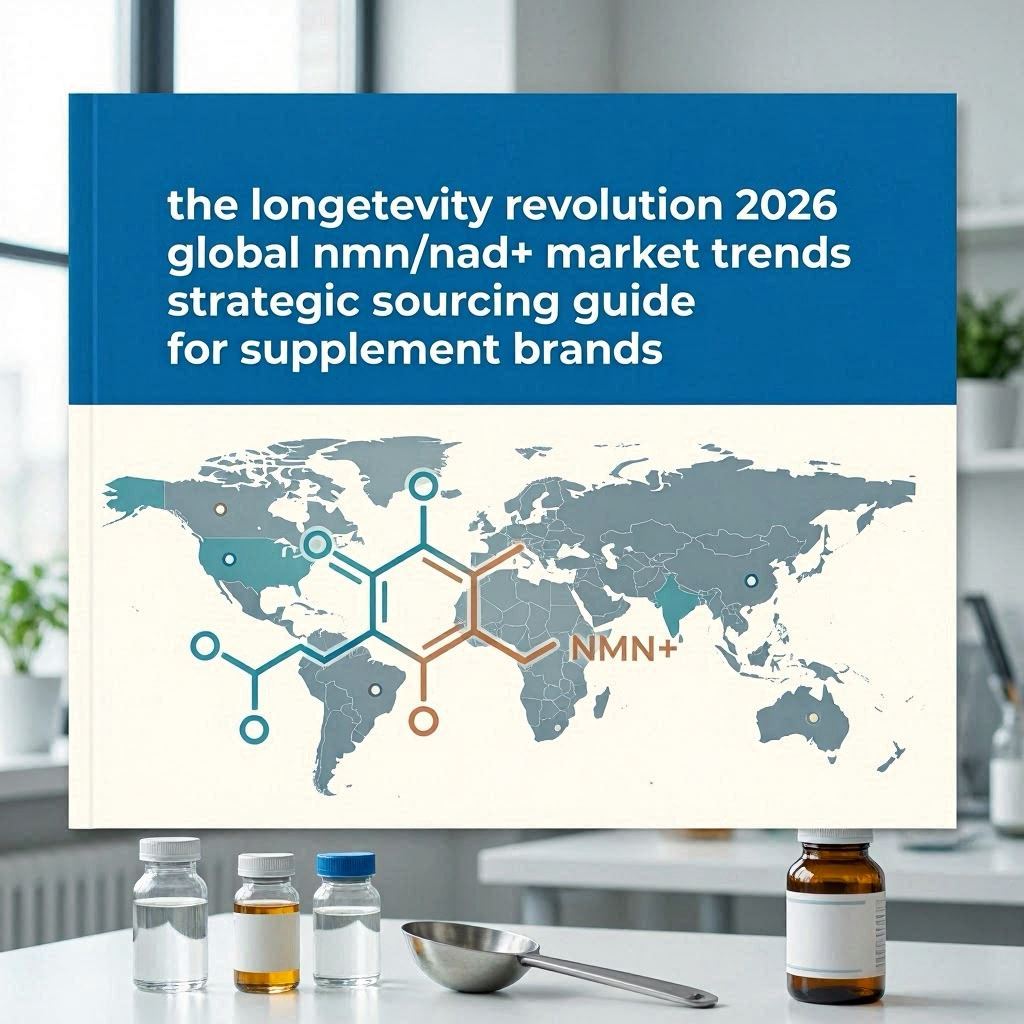
Executive Summary
The global market for Nicotinamide Mononucleotide (NMN) and NAD+ precursors is undergoing a tectonic shift. As of 2026, the industry has transitioned from a niche “anti-aging” segment into a multi-billion-dollar “longevity and cellular health” powerhouse. For B2B sellers and cross-border e-commerce brands, NMN represents one of the highest-margin categories in the nutraceutical sector, characterized by high customer loyalty and increasing scientific validation. This article explores the current market landscape, scientific foundations, and strategic OEM/ODM considerations to help sellers build a sustainable and compliant NMN brand.
Part 1: Market Landscape and 2026 Growth Projections
1.1 The $1.5B Milestone
According to 2025 market reports, the global NMN market is projected to surpass $1.5 billion by late 2026, growing at a CAGR of over 15%. The North American market remains the largest consumer base, while the Asia-Pacific region, led by China and Japan, shows the fastest growth in manufacturing capacity and consumer adoption.
1.2 The Shift from Anti-Aging to Longevity
In 2026, the marketing narrative has evolved. Consumers are no longer just looking to “look younger”; they are seeking “biohacking” tools to optimize healthspan. Sellers who position NMN as a foundational cellular energy booster (ATP production) rather than just a cosmetic fix are seeing 40% higher conversion rates on independent platforms.
Part 2: The Science of NAD+ and NMN: A Technical Deep Dive for Sellers
2.1 The Biological Mechanism: Why NAD+ Matters
Nicotinamide Adenine Dinucleotide (NAD+) is a coenzyme found in all living cells and is essential for life. It plays two critical roles:
Energy Metabolism : Converting nutrients into ATP.
DNA Repair : Acting as a substrate for Sirtuins (longevity genes) and PARP (DNA repair enzymes).
2.2 NMN vs. NR vs. NAD+
Sellers often ask: “Why sell NMN instead of NAD+ itself?” Oral NAD+ is poorly absorbed due to its large molecular size. NMN, however, is a direct precursor that enters cells via specific transporters (like Slc12a8), making it far more bioavailable.
Part 3: OEM/ODM Strategy: Navigating Purity and Production
3.1 Purity is the Ultimate B2B USP
In a crowded market, “99.9% Purity” is the baseline. High-quality ODM services now offer Enzymatic Synthesis (Biological Enzyme Method) which mimics the body’s natural production, resulting in higher stability and lower chemical residue compared to traditional chemical synthesis.
3.2 Stability and Bioavailability Innovations
The 2026 trend is Liposomal NMN. By encapsulating NMN in phospholipid bubbles, the active ingredient bypasses gastric acid destruction, increasing absorption by up to 3-5 times. For sellers, this is a premium tier product that justifies a 50% higher price point.
Part 4: Regulatory Compliance: USA and Europe Outlook
4.1 FDA Status (2025-2026 Update)
While the FDA initially categorized NMN under “drug preclusion,” the massive consumer demand and clinical safety data led to a period of enforcement discretion. Sellers must avoid making “disease claims” (e.g., “Cures Alzheimer’s”). Instead, use structure-function claims like “Supports cellular energy” or “Promotes healthy aging.”
4.2 EFSA and UK Guidelines
In the EU, NMN is often classified as a “Novel Food.” Navigating this requires strict adherence to batch testing for heavy metals and microbial purity.
Part 5: FAQ for B2B Sellers and Professional Buyers
Q1: What is the recommended dosage for a white-label NMN product?
A1: Most clinical studies suggest 250mg to 500mg daily for healthy adults. Offering a 500mg “Double Strength” capsule is currently the most popular SKU for independent brands.
Q2: How do I verify the authenticity of an NMN supplier?
A2: Demand a third-party Certificate of Analysis (COA), an ISO 22000 or GMP factory certification, and specifically ask for the “Enzymatic Synthesis” report to ensure no harmful chemical catalysts are present.
Q3: Can NMN be combined with other ingredients for a private label formula?
A3: Yes. The most effective “Longevity Stacks” include NMN with Resveratrol, Pterostilbene, or Quercetin. These ingredients activate Sirtuins synergistically with NAD+ boosters.
Q4: What is the shelf life of high-purity NMN? A4: High-purity NMN (99%+) is relatively stable at room temperature but sensitive to humidity. In standard HDPE bottles, the shelf life is typically 24 months. For premium brands, amber glass bottles or blister packs are recommended to maintain potency.
Conclusion
For medium and small sellers, the NMN/NAD+ sector is no longer about “wait and see.” It is about precision sourcing and scientific positioning. By partnering with a technologically advanced OEM/ODM partner, brands can leverage clinical-grade ingredients to capture the 2026 longevity wave.