










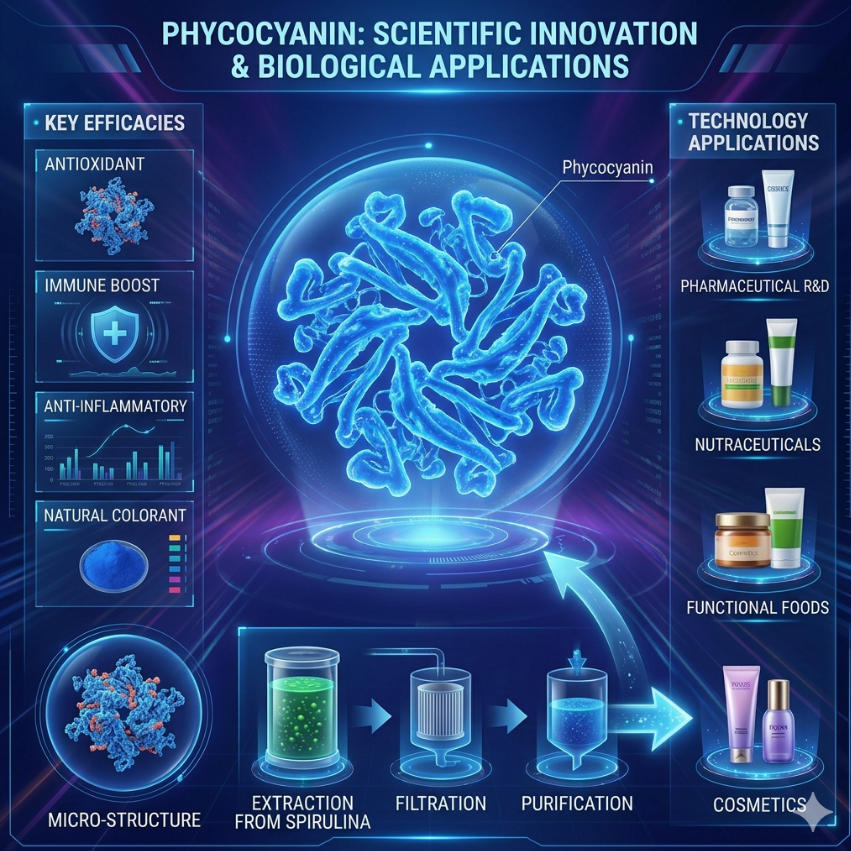
Phycocyanin — known in Chinese as 藻蓝蛋白 — is a phycobiliprotein pigment-protein complex derived primarily from the cyanobacterium Arthrospira platensis (Spirulina). It is the molecule responsible for Spirulina’s characteristic deep blue color, and it represents one of the most intensively studied bioactive compounds in modern functional nutrition science. As natural product research accelerates and the global nutraceutical market demands scientifically validated clean-label ingredients, phycocyanin has emerged as a priority compound across multiple disease research areas — from chronic inflammation and oxidative stress to oncology and neurodegeneration.
This article reviews the current state of phycocyanin functional research, organized by therapeutic area, with reference to peer-reviewed literature.
Structure and Bioactive Mechanism: Phycocyanobilin at the Core
Phycocyanin is composed of two subunit chains — an α chain carrying one phycocyanobilin (PCB) chromophore attached at cysteine 84, and a β chain carrying two PCB chromophores at cysteine 84 and 155. The PCB chromophore is the primary driver of phycocyanin’s biological activity. Structurally, PCB belongs to the linear tetrapyrrole family — the same chemical class as biliverdin and bilirubin, the mammalian bile pigments known for their endogenous antioxidant and anti-inflammatory roles.
Within cells, PCB functions through at least three converging mechanisms, as detailed in a comprehensive mechanistic review published in Nutrients (McCarty, 2022, PMC9185767): inhibition of NADPH oxidase isoforms that generate reactive oxygen species (ROS); agonism of the aryl hydrocarbon receptor (AhR), which induces regulatory T cell activity and upregulates Nrf-2-mediated phase 2 antioxidant enzyme expression including heme oxygenase-1 (HO-1); and activation of anti-inflammatory signaling through biliverdin reductase (BVR), the same enzyme that converts biliverdin to bilirubin in human physiology.
This mechanistic convergence — oxidant scavenging, transcriptional upregulation of endogenous antioxidant defenses, and immune modulation — provides the biological foundation for phycocyanin’s broad-spectrum activity across disease models.
Research Area 1: Antioxidant Activity — the Original Discovery
The foundational evidence for phycocyanin as a bioactive compound was established in 1998 by Romay and colleagues, who first reported its antioxidant and anti-inflammatory properties in blue-green algae (Journal of Pharmacy and Pharmacology, PMID 9495584). Their study demonstrated that phycocyanin could scavenge hydroxyl radicals with an IC50 of 0.91 mg/mL and alkoxyl radicals with an IC50 of 76 μg/mL, with activity comparable to known radical scavengers DMSO and Trolox. Critically, it also inhibited liver microsomal lipid peroxidation (IC50 = 12 mg/mL) — a mechanistically relevant finding because lipid peroxidation is a central driver of membrane damage in chronic disease.
More recently, a 2025 review in the International Journal of Food Science and Technology confirmed that phycocyanin from multiple cyanobacterial species demonstrates consistent antioxidant activity, and noted that its water solubility, non-toxicity, and characteristic blue color make it attractive across pharmaceutical, food, and cosmetic applications. The review further noted that Arthrospira-derived dried biomass products have been categorized as Generally Recognized as Safe (GRAS) by the US FDA, providing a regulatory foundation that most novel bioactive ingredients lack.
Research Area 2: Anti-Inflammatory Effects — Mechanisms and Disease Models
Following the initial antioxidant characterization, Romay’s group extended their investigation across twelve experimental models of inflammation, publishing findings in European Journal of Pharmacology (PMID 9754867 and PMID 12769719). Across all twelve models, phycocyanin demonstrated anti-inflammatory effects in a dose-dependent manner, reducing edema, inhibiting histamine release, suppressing myeloperoxidase (MPO) activity — a marker of neutrophil infiltration — and lowering prostaglandin E2 (PGE2) and leukotriene B4 (LTB4) levels. The magnitude of anti-inflammatory effect was compared to indomethacin in several models, with phycocyanin achieving comparable edema reduction at doses of 50–300 mg/kg orally.
A systematic review published in Biomedicine & Pharmacotherapy (2022) synthesized the application of phycocyanin against inflammatory diseases across multiple organ systems, including acute lung injury, liver inflammation, cardiovascular disease, and cerebrovascular conditions. In a sepsis-induced acute lung injury (ALI) model, phycocyanin at 60 mg/kg reduced TNF-α in bronchoalveolar lavage fluid from 428 pg/mL back toward baseline levels, and similarly reduced IL-1β and IL-6, while upregulating the cytoprotective enzyme HO-1.
A 2025 study published in Algal Research investigated C-phycocyanin from Spirulina platensis as an anti-inflammatory agent in human chondrocyte cells, contributing to the evidence base for its application in joint and cartilage-related inflammatory conditions — a relevant direction given the global burden of osteoarthritis.
The molecular pathway increasingly implicated in these effects is inhibition of NF-κB signaling — the master transcription factor governing inflammatory gene expression — alongside COX-2 downregulation and modulation of the MAPK pathway.
Research Area 3: Neuroprotection — Alzheimer’s, Parkinson’s, and Brain Injury
Neurodegenerative disease represents one of the most actively developing phycocyanin research frontiers. The rationale is mechanistically sound: brain aging is characterized by elevated oxidative stress, neuroinflammation, and mitochondrial dysfunction — all pathways where phycocyanin’s PCB chromophore has demonstrated activity.
A review in Current Pharmaceutical Design (PMC9185767) summarized preclinical evidence showing that C-phycocyanin and its chromophore phycocyanobilin achieved marked protective effects in rodent and cell culture models of ischemic stroke and multiple sclerosis, and proposed that similar protective mechanisms may be relevant in Alzheimer’s disease, Parkinson’s disease, and neurological complications of COVID-19. The proposed mechanism centers on PCB’s structural homology to biliverdin, allowing it to interact with biliverdin reductase and modulate the same redox-protective signaling utilized by the endogenous biliverdin/bilirubin system.
For Alzheimer’s disease specifically, the ScienceDirect review noted that phycocyanin’s antioxidant and anti-inflammatory effects can reduce oxidative stress in neurons, suppress neuroinflammation, and modulate immunity — properties that may help alleviate damage caused by neurodegeneration. In Alzheimer’s and Parkinson’s models, phycocyanin has also been studied for its ability to inhibit the fibrillary aggregation of misfolded proteins, which is central to both disease pathologies.
For acute brain injury, a 2025 study in Molecular Neurobiology demonstrated that phycocyanin restored NAD+ levels and reduced oxidative stress and neuroinflammation in an experimental intracerebral hemorrhage model — extending the neuroprotective evidence into acute injury contexts.
Research Area 4: Anticancer Activity — Apoptosis, Autophagy, and Cell Cycle Arrest
Phycocyanin has been identified as a potential anticancer drug based on its ability to block tumor cell cycle progression, induce apoptosis, and trigger autophagy in malignant cells. A review in Journal of Cancer (PMID 29151925) concluded that phycocyanin can serve as a promising anticancer agent based on accumulating evidence across multiple cancer cell lines, with high efficacy and low toxicity as its principal distinguishing characteristics.
A comprehensive review in Life (MDPI, 2021) summarized in vitro and in vivo data across multiple tumor types. Arthrospira-derived phycocyanin demonstrated antiproliferative activity against HeLa cells (cervical cancer), HepG2 cells (hepatocellular carcinoma), A549 cells (lung cancer), and additional cell lines through mechanisms including induction of caspase-dependent apoptosis, G0/G1 cell cycle arrest, and — in some models — selective cytotoxicity sparing healthy cells. The authors noted that Arthrospira dried biomass has GRAS status from the US FDA, underpinning its safety profile relative to synthetic chemotherapeutics.
It is important to note that anticancer research remains largely preclinical; well-powered human clinical trials in oncology are still lacking, and this area should be framed as an emerging research direction rather than an established clinical application.
Research Area 5: Cardiovascular and Metabolic Protection
Phycocyanin is recognized for its cardiovascular protective properties, with IntechOpen’s chapter on phycocyanin noting that these effects are primarily mediated through antioxidant activity — reducing LDL oxidation, inhibiting foam cell formation in atherosclerotic plaques, and modulating lipid metabolism.
A clinical trial in adults with metabolic syndrome using a spirulina liquid extract standardized to phycocyanin (approximately 20 mg phycocyanin per day for 12 weeks) demonstrated improvements in triglycerides, HDL cholesterol, and urinary isoprostanes compared to placebo, with stable liver safety markers and no serious adverse events reported. This represents one of the few human clinical data points for isolated phycocyanin activity.
The CD59 gene pathway has been mechanistically implicated in phycocyanin’s anti-atherosclerotic effects, with research demonstrating inhibition of atherosclerotic plaque development in ApoE(-/-) mouse models — a well-validated preclinical cardiovascular disease system.
Market Context and Formulation Implications
The global phycocyanin market is projected to reach USD 245.5 million by 2027, driven by demand across food, cosmetic, and pharmaceutical industries. Phycocyanin price varies considerably by purity grade — from USD 360/kg for lower-grade extracts to USD 72,460/kg for pharmaceutical-grade purified phycocyanin — making purity specification a critical purchasing parameter for B2B formulators.
For supplement and functional food brands, phycocyanin offers a convergence of rare advantages: it is water-soluble, carries FDA GRAS status through its Spirulina source, has a visually distinctive natural blue color that supports clean-label positioning, and possesses a growing peer-reviewed evidence base across antioxidant, anti-inflammatory, neuroprotective, and metabolic applications. Formulation formats include standardized powders for capsules and tablets, water-soluble liquids for beverage applications, and — in emerging research — nanoencapsulated forms designed to improve thermal and pH stability.
Conclusion: A Multifunctional Compound at the Intersection of Nutrition and Medicine
Phycocyanin occupies an unusual position in the bioactive compound landscape: it is simultaneously a widely commercialized natural colorant, a nutritional supplement ingredient with consumer recognition through Spirulina, and a serious candidate drug compound under investigation across neurodegenerative disease, oncology, and metabolic disease research programs. Its chromophore phycocyanobilin’s structural homology to endogenous human bile pigments provides a compelling mechanistic rationale for its broad biological activity that goes beyond the generic “natural antioxidant” category.
The most active research frontiers as of 2025 are neurodegeneration (Alzheimer’s, Parkinson’s, and acute brain injury), tumor cell apoptosis and autophagy, joint and cartilage inflammation, and cardiovascular metabolic protection. For brands and formulators seeking ingredients with both current market momentum and deep scientific foundation, phycocyanin represents a compelling opportunity — particularly as extraction and purification technologies continue to improve the availability of high-purity, pharmacologically active material.
NuCoreBio supplies phycocyanin and Spirulina-derived bioactive ingredients with GMP, ISO 22000, and HACCP certification and full HPLC purity verification. OEM and ODM formulation services available from MOQ 500 units. Contact us for samples and B2B pricing.