










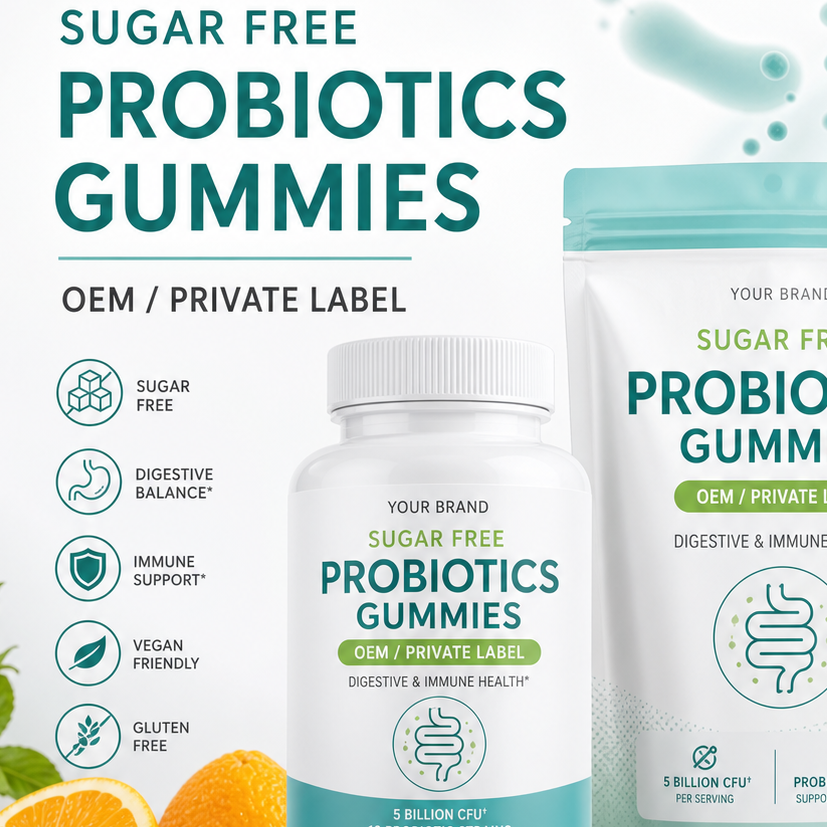
1. The Probiotics Gummy Market — Scale, Growth, and the Sugar-Free Premium Opportunity
The probiotic supplement market is one of the most mature and well-established wellness categories globally, with probiotics consistently ranking as the #1 supplement concern among US consumers in syndicated survey data. But within this broad market, probiotics gummies—and specifically sugar-free variants—represent the category’s fastest-growing and most margin-rich sub-segment.
The global probiotics gummies market was valued at USD 178 million in 2024 and is projected to reach USD 269 million by 2032 at a 6.2% CAGR. The sugar-free sub-segment specifically is growing 2–3x faster than the category average, representing an estimated 25–35% of all new probiotic product introductions in 2025 and commanding a retail price premium of 20–30% over standard sweetened alternatives. Private label and DTC subscription models collectively captured 40–45% of unit volume in 2025.
| Market Metric | Value |
| Global Probiotics Gummies Market (2024) | USD 178 million |
| Projected Market (2032) | USD 269 million (CAGR 6.2%) |
| Sugar-Free Probiotic Growth vs. Category Avg. | 2–3× faster |
| Sugar-Free SKU Market Share (2025 new launches) | 25–35% |
| Retail Price Premium: Sugar-Free vs. Standard | +20–30% |
| North America Market Share (Probiotics Gummies) | ~55% |
| Nutraceutical Gummies Market (2025) | USD 27.14 billion |
2. Probiotic Strain Science — What Matters for Gummy Formulation
Not all probiotic strains survive the technical challenges of gummy manufacturing. The combination of heat, moisture, and acidic ingredients creates a hostile environment for live cultures. Understanding strain selection is critical for OEM buyers commissioning a quality product.
Top Strains for Gummy Survival : Lactobacillus acidophilus (NCFM strain), Bifidobacterium animalis subsp. lactis (BB-12®), and Lactobacillus rhamnosus (GG strain) are among the most heat and moisture tolerant when properly microencapsulated. Spore-forming strains such as Bacillus subtilis DE111® and Bacillus coagulans (GBI-30, 6086) are increasingly popular for gummies because their spore state is inherently stable against heat and moisture, eliminating the microencapsulation requirement.
CFU Dosing and Overage: Label claims must be met at the product’s expiration date, not at time of manufacture. Given the expected 15–30% CFU die-off during manufacturing and an additional 10–20% annual die-off during shelf life, manufacturers must add overage (typically 2–3× the label claim CFU count at time of manufacture). A product claiming 5 billion CFU must be manufactured at 10–15 billion CFU to reliably meet the label claim at 24-month expiration.
Microencapsulation Technology : Advanced OEM manufacturers use double-layer microencapsulation (e.g., protein + lipid coating) to protect non-spore-forming strains through gummy processing. This technology increases manufacturing cost by $0.05–0.15/unit but dramatically improves end-of-shelf-life CFU retention. Mordor Intelligence reports that advancements in microencapsulation are among the key drivers of the probiotic gummies market’s growth trajectory.
3. Sugar-Free Formulation for Probiotics — The Technical Intersection
The marriage of “sugar-free” and “probiotics” in a single gummy product is technically demanding. Standard probiotic gummy bases use glucose syrup or sucrose as the primary structural carbohydrate, which provides both sweetness and the aqueous environment that helps maintain live cultures. Removing sugar creates formulation challenges:
Water Activity Control : Live probiotic cultures need some moisture for viability, but high water activity (Aw >0.55) promotes microbial growth and cultural die-off. Sugar-free matrices using erythritol and allulose must be precisely engineered to maintain the narrow Aw window (0.45–0.55) that supports shelf life without destroying cultures.
Temperature Sensitivity During Manufacturing : Most live probiotic cultures begin dying at temperatures above 50–60°C. Gummy manufacturing typically requires cooking to 90–105°C. Qualified manufacturers use a cold-add process where the microencapsulated probiotic blend is added after the gummy base cools below 40°C (tumble coating or last-step injection). This requires specialized equipment and strict temperature monitoring—a key differentiator for quality OEM factories.
Packaging for CFU Preservation : Oxygen and moisture are the primary enemies of probiotic viability. Sugar-free probiotic gummies should be packaged in: (1) Nitrogen-flushed HDPE bottles with induction seals and desiccant packets; or (2) Individual blister packs with moisture-barrier film (PVDC or aluminum foil laminate). Packaging choice can account for 30–50% of the difference in end-of-shelf-life CFU retention between competing products.
4. Regulatory Framework for Sugar-Free Probiotics Gummies Across Five Markets
EFSA’s tightening regulatory environment represents both a challenge and a quality moat for serious OEM-backed brands. As regulatory scrutiny strengthens clearer health claim pathways for gut health, brands with scientifically documented strains and transparent CFU claims gain significant advantage.
| Market | Body | Probiotics Status & Claims | “Sugar-Free” Claim Standard |
| USA | FDA | Legal S/F supplement; general structure/function claims only (“supports digestive health”) | <0.5g sugar/serving (21 CFR 101.60) |
| UK | FSA | Food supplement; “Live cultures” claim permitted; no specific disease claims | <0.5g sugar/100g |
| Australia | TGA | Listed medicines with AUST L; documented strains required; CFU verified at expiry | No added sugar declaration required |
| Canada | Health Canada | Natural health product NPN; evidence of strain identity and viability required | <0.5g sugar/serving |
| Germany/EU | EFSA/BfR | General food supplement; EFSA approving novel probiotic strains; “live cultures” claim pathway emerging | <0.5g sugar/100g |
5. OEM Business Guide — How to Source a Quality Sugar-Free Probiotics Gummy Manufacturer
The quality gap between probiotic gummy manufacturers is wider than in almost any other supplement category, precisely because of the technical complexity of maintaining live culture viability. When evaluating a China-based OEM manufacturer, cross-border e-commerce sellers should apply the following criteria:
Certification Stack : Minimum: GMP + ISO 22000 + HACCP. Strong advantage: FSSC 22000 (Food Safety System Certification—the gold standard for food safety management), HALAL certification (access to 1.8 billion Muslim consumers globally), BRC Grade
Stability Testing Evidence : Request accelerated stability data (40°C/75% RH for 6 months) for the probiotic gummy formula, specifically showing CFU count at simulated end-of-shelf-life. This is the single most important quality differentiator.
Strain Documentation: Request genus, species, and strain-level documentation (e.g., Lactobacillus acidophilus NCFM, not just “Lactobacillus acidophilus”). Strain-level documentation is required for TGA (Australia) and Health Canada NPN applications and provides marketing credibility.
Cold Chain Logistics Capability : While spore-forming probiotics are shelf-stable, non-spore-forming strains may require refrigerated shipping. Clarify the factory’s logistics capabilities and confirm whether the selected formula is designed for ambient or cold-chain distribution.
6. FAQ — Sugar-Free Probiotics Gummies OEM FAQ
Q1: What is the minimum viable CFU count for a sugar-free probiotic gummy to be credible to health-conscious consumers?
A: Consumer expectations and competitive benchmarking in 2025 indicate that 1–10 billion CFU per serving is the most commercially successful range for adult probiotic gummies. Products at <500 million CFU are increasingly perceived as underdosed by informed consumers. The sweet spot for a competitive Amazon or Shopify listing is 3–5 billion CFU per serving, with a documented multi-strain formula (3–6 strains) and clear “guaranteed potency through expiration date” language on the label. Going above 10 billion CFU can command a premium price point but requires stronger stability data investment from the OEM manufacturer.
Q2: Can I add prebiotics to my sugar-free probiotic gummy formula to create a synbiotic product?
A: Yes, and this is a strong market differentiation strategy. The most commonly used prebiotics compatible with sugar-free gummy matrices are: (1) Inulin/FOS (fructooligosaccharides)—selectively fermented by Bifidobacteria and Lactobacillus; can be included at 1–3g per serving but adds slight sweetness; (2) GOS (galactooligosaccharides); (3) Apple Pectin—works double duty as a gelling agent (partially replacing the pectin base) and prebiotic substrate. However, adding prebiotics at effective doses (>1g) to a gummy serving is challenging because it increases the gummy size significantly. The common solution is to distribute the prebiotic across more gummies per serving (4–6 gummies/serving) or use a combination product with smaller prebiotic inclusion.
Q3: How do I differentiate my sugar-free probiotic gummy on Amazon when the category is saturated with similar products?
A: Five proven differentiation strategies for 2025–2026: (1) Strain specificity—name the specific strains and their documented benefits (e.g., “Lactobacillus rhamnosus GG—the world’s most clinically studied probiotic strain”) rather than just “10 billion CFU probiotics”; (2) Third-party certification—NSF, USP verified, or Informed Sport® badges command 20–40% price premium; (3) Unique format—consider individual daily serving packets (sachet/strip pack) versus traditional bottles for premium DTC positioning; (4) Target audience specialization—women’s gut+vaginal health (L. reuteri, L. crispatus), men’s athletic recovery, or pediatric formulas (age-specific strain documentation); (5) Subscription + loyalty model on Shopify DTC with gut health content ecosystem.
Q4: What is a realistic timeline and MOQ for launching a custom sugar-free probiotic gummy with a certified China OEM factory?
A: For custom sugar-free probiotic gummies from a GMP/FSSC 22000-certified China OEM manufacturer: MOQ is typically 3,000–5,000 units for standard base formulas, with higher MOQ (5,000–10,000 units) sometimes required for custom probiotic strain combinations due to the minimum purchase requirements of certified probiotic ingredient suppliers. Total development timeline from formula confirmation: Formula approval (including probiotic strain sourcing, microencapsulation trial, and stability assessment): 14–21 days. Pilot batch production and QC testing (CFU count, microbiology panel, moisture, taste evaluation): 21–28 days. Full production and packaging: 20–30 days. Third-party lab verification and documentation: 7–14 days. Total: 62–93 days to launch-ready finished goods.
7. References
1. Hill C et al. (2014). Expert consensus document: The International Scientific Association for Probiotics and Prebiotics consensus statement on the scope and appropriate use of the term probiotic. Nature Reviews Microbiology, 12, 506–514.
2. IndexBox (2026). United States Sugar-Free Probiotics Market Analysis & Forecast. indexbox.io
3. Mordor Intelligence (2025). Nutraceutical Gummies Market—Probiotic Segment. mordorintelligence.com
4. Intel Market Research (2025). Probiotics Gummies Market Outlook 2025–2032. intelmarketresearch.com
5. Global Growth Insights (2025). Probiotics Gummies Market Share 2025–2033, CAGR 5.7%. globalgrowthinsights.com
6. Markwide Research (2026). Sugar-Free Gummy Market: Formulation, Regional Trends & Forecast. markwideresearch.com
7. Sanders ME. (2019). Probiotics and microbiota composition. BMC Medicine, 17, 61.