










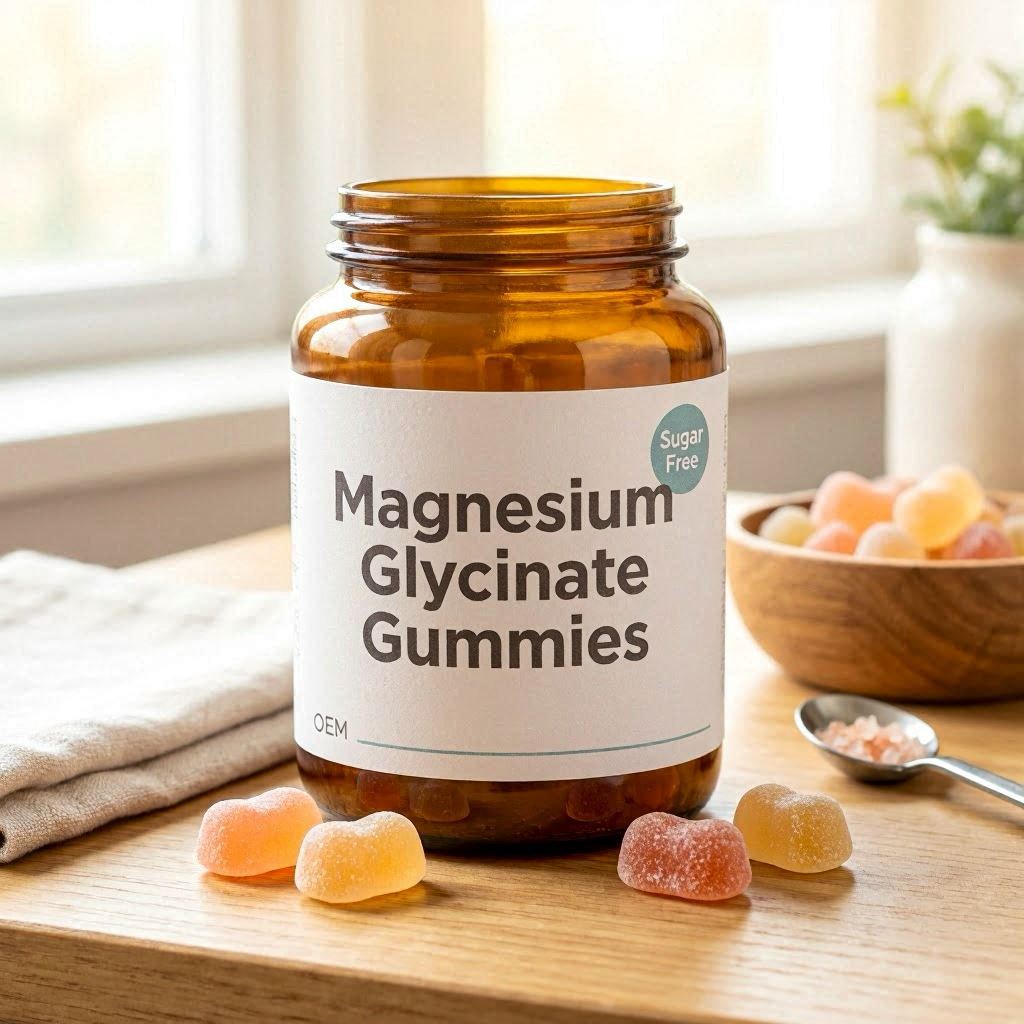
The global dietary supplement market is experiencing a profound paradigm shift. Modern consumers are no longer satisfied with traditional pill and capsule delivery formats; however, their transition to functional confectionery comes with strict caveats. Today’s high-lifetime-value (LTV) demographic demands zero sugar, high bioavailability, and clean-label verification. For cross-border e-commerce brands on platforms like Amazon, TikTok Shop, and Shopify, “Sugar-Free Magnesium Glycinate Gummies” has emerged as a hyper-growth category. Yet, from a contract manufacturing perspective, executing this specific formulation requires solving intricate biochemical and structural engineering challenges.
The Bioavailability Threshold: Why Magnesium Glycinate Dominates
Magnesium is an essential cofactor in more than 300 enzymatic systems within the human body, regulating protein synthesis, muscle and nerve function, blood glucose control, and blood pressure. However, inorganic magnesium salts—such as magnesium oxide or magnesium sulfate—possess notoriously low fractional absorption rates (often under 4%) and frequently induce gastrointestinal distress, osmotic diarrhea, and abdominal cramping due to their hydrophilic properties in the intestinal lumen.
For premium brand positioning, Magnesium Glycinate (structurally known as Magnesium Bisglycinate) represents the gold standard. In this chelated form, magnesium is non-ionically bonded to two molecules of glycine, an inhibitory neurotransmitter. This chemical architecture protects the magnesium ion from reacting with dietary phytates and polyphenols in the stomach. Instead of relying on saturable, mineral-specific ion channels, the intact chelate utilizes dipeptide transport pathways (PepT1) in the intestinal mucosa. This results in significantly higher systemic bioavailability, rapid mucosal kinetics, and excellent gastrointestinal tolerance.
Technical Barriers in Sugar-Free Gummy Stabilization
Transitioning from standard sucrose-corn syrup matrices to a functional sugar-free vehicle while incorporating a high payload of chelated magnesium presents severe manufacturing hurdles for standard OEM facilities.
- Viscosity and Shear Stress in the Cooker: Magnesium glycinate is a bulky, hydrophobic molecule compared to highly soluble vitamins. When introduced at therapeutic dosages into a sugar-free gelling matrix, it alters the rheological properties of the slurry, drastically increasing viscosity and causing premature gelling or “set-up” before deposition into molds.
- Syneresis and Texture Degeneracy: Traditional sugar-free sugar substitutes like low-grade maltitol syrups can be highly hygroscopic. If the water activity ($a_w$) of the final gummy is not strictly controlled below 0.60, thermodynamic migration of water molecules occurs. This leads to syneresis (the weeping of liquid from the gel matrix), causing the gummies to become sticky, lose structural integrity, and deform under the thermal stresses of cross-border shipping and international warehousing.
- Taste Masking of the Amino Acid Profile: Glycine possesses a distinct, slightly metallic, and sweet-salty undertone. In the absence of masking sugars, this flavor profile can easily alienate consumers. Advanced contract manufacturing requires molecular taste-masking technology, utilizing organic acids (such as citric and malic acids) alongside natural polyols and advanced flavor modulators to neutralize the organoleptic deficits of the mineral payload.
Advanced OEM Manufacturing Protocols: Pectin vs. Gelatin and Polyol Matrix Design
To secure compliance across both US and European markets, advanced OEM protocols utilize a 100% plant-based, clean-label architecture. Vegetable pectin (derived from citrus peels or apple pomace) is highly preferred over porcine or bovine gelatin. Pectin creates a clean, short-bite texture, withstands higher thermal thresholds during shipping (up to 45°C without melting, unlike gelatin which deforms at 35°C), and unlocks access to Vegan, Halal, and Kosher certifications—essential multipliers for e-commerce conversion rates.
The sugar-free bulking vehicle is constructed using a synergistic blend of sugar alcohols and soluble prebiotic fibers:
- Maltitol and Sorbitol Syrups: Provide the molecular weight and crystalline lattice necessary to simulate the mouthfeel and moisture-retention properties of sucrose.
- Erythritol: Added to provide a clean cooling effect that assists in taste-masking the metallic notes of the mineral chelate.
- Fructooligosaccharides (FOS) or Inulin: Act as structural texturizers while allowing brands to claim “fiber-enriched” benefits on their supplement facts panels.
Crucially, the manufacturing process must utilize high-shear, vacuum-jacketed mixing vessels to achieve a homogenous colloid suspension of the magnesium glycinate before it enters the starchless depositing lines. Automated inline pH monitoring must maintain the slurry within a narrow window (typically pH 3.4 to 3.8) to ensure optimal pectin cross-linking and gelation kinetics without degrading the chelated structure of the active mineral.
Quality Assurance, Analytical Verification, and Regulatory Compliance
For institutional buyers and global brand owners, analytical verification is non-negotiable. Standard quality control frameworks at the OEM level must include:
- Inductively Coupled Plasma Mass Spectrometry (ICP-MS): To quantify the exact elemental magnesium content per serving and guarantee heavy metal safety (compliance with California Proposition 65 limits for Lead, Cadmium, Arsenic, and Mercury).
- High-Performance Liquid Chromatography (HPLC) and Fourier-Transform Infrared Spectroscopy (FTIR): To verify that the raw material is a true, fully reacted bisglycinate chelate rather than a cheap, unreacted dry blend of magnesium oxide and free glycine.
- Stability Chambers (Real-Time and Accelerated): Testing at 40°C and 75% Relative Humidity (RH) to ensure a stable 24-month shelf life without active ingredient degradation or matrix liquefaction.
All manufacturing documentation must align with FDA 21 CFR Part 111 (Current Good Manufacturing Practice for Dietary Supplements) and European Regulation (EC) No 1924/2006 on nutrition and health claims. Labeling descriptions must avoid unapproved medical claims; instead of claiming to “cure insomnia or anxiety,” marketing text must be framed around validated functional claims, such as “supports normal muscle function, promotes relaxation, and contributes to the maintenance of normal bones and nervous system health.”
B2B FAQ:
Q1: What is the maximum elemental magnesium payload achievable per gummy without compromising the structural integrity of a sugar-free pectin matrix?
A1: Through advanced high-shear dispersion and vacuum-homogenization techniques, the optimal therapeutic threshold is 50 mg of elemental magnesium (derived from approximately 400 mg of pure Magnesium Bisglycinate chelate) per individual 4-gram gummy. Pushing beyond this payload alters the critical water-binding capacity of the pectin network, leading to grittiness, structural fracturing, and accelerated syneresis during storage.
Q2: How does your OEM process ensure that the magnesium glycinate is a true chelate and not a physical blend of magnesium oxide and glycine?
A2: Our quality control protocol subjects every incoming batch of raw materials to Fourier-Transform Infrared Spectroscopy (FTIR) fingerprinting and X-ray Diffraction (XRD) analysis. True magnesium bisglycinate displays distinct, coordinated covalent bond vectors between the nitrogen atom of the amino group and the magnesium ion, which can be clearly differentiated from the distinct structural profiles of unreacted magnesium oxide and isolated glycine molecules.
Q3: Which specific sugar-free binding agents are utilized to prevent the gummies from melting or sticking during transit to international fulfillment centers?
A3: We substitute traditional corn syrup with a proprietary, highly heat-stable matrix consisting of hydrogenated starch hydrolysates (HSH), non-GMO maltitol syrup, and high-methoxyl (HM) apple pectin. This specific configuration raises the thermal deformation threshold of the finished product to 45°C (113°F) and keeps the internal water activity ($a_w$) strictly under 0.62, eliminating cross-linking failure and stickiness under typical non-refrigerated maritime and dry-van shipping conditions.
Q4: What structural health claims can be safely utilized on Amazon and TikTok product listings for sugar-free magnesium glycinate gummies under FDA guidelines?
A4: Brands can legally deploy structure/function claims under FDA 21 CFR 101.93. Permissible phrasing includes: “Supports natural muscle relaxation and recovery,” “Promotes a calm and balanced nervous system,” “Helps maintain normal cardiovascular function,” and “Supports bone density and joint health.” The labeling must exclude any direct or implied reference to clinical pathologies such as “chronic insomnia,” “generalized anxiety disorder,” or “cardiac arrhythmia” to avoid regulatory compliance actions.